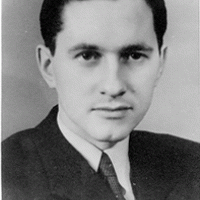
Keres Defeats Winter

Submitted by NM GreenLaser on Sat, 10/31/2009 at 11:35am.


Paul Keres was born in Narva, Estonia January 7, 1916 and died June 5, 1975. From the 1930s to the 1970s he was one of the world's best players. After winning the AVRO tournament in 1938 he was to play Alexander Alekhine for the world championship. In 1939, World War II began and the match never took place. Keres played in the 1948 World Championship tournament and finished third. Later, he played in six Candidates' tournaments. He came in second in four of these. Keres has been described as the best player who was never world champion. The following game brought Keres international attention. Keres played in the Olympiad for Estonia against William Winter (1898-1955), the British champion.


» posted in Chess Players
 

Comments:

by NM GreenLaser - 23 days ago
Chester, NY United States
Member Since: Oct 2007
Member Points: 1425

pingshiyu and m0nst9r, thanks for reading and commenting. When you make the comments, "careless" and "reckless," you could be right. However, it would help me to understand your point if you could be specific and indicate which move(s) of which player(s) you are evaluating that way. In nearly every game there are mistakes. The mistakes are often obvious after the game. We learn from trying to find them. We study both seemingly "perfect" games and "flawed" games.

by m0nst9r - 23 days ago
Florida United States
Member Since: Feb 2009
Member Points: 60

Just what I was going to say, "Reckless!"

by chessoholicalien - 25 days ago
Missouri United States
Member Since: Dec 2008
Member Points: 791

As well as being a great chessplayer he was also apparently much liked by his fellow grandmasters.

by pingshiyu - 25 days ago
London United Kingdom
Member Since: May 2009
Member Points: 212

what a careless game

by NM GreenLaser - 26 days ago
Chester, NY United States
Member Since: Oct 2007
Member Points: 1425

RobertABrown, of course, Keres was an all-time great. That is probably why this game has already had over 1,000 reads. I cannot presume to select numbers in order to rank the best. We can only guess how a match with Alekhine would have turned out for Keres. We do know that Keres defeated Euwe in a match in 1939-40, but only 7.5-6.5. Both Euwe and Alekhine had the advantage over Keres in match experience. In any case, Keres was the right candidate to challenge for the title at the time. He won at AVRO (on tie-breaks) to qualify to play. However, I am guessing that Alekhine's chances were clearly better than "Paul Keres would almost certainly have become world champion."

by RobertABrown - 26 days ago
Terrace, BC Canada
Member Since: Aug 2007
Member Points: 1213

If the Alechjin-Keres match been played, Paul Keres would almost certainly have become world champion. Thirty years later, at the candidates tournament in Curacao, he was still vying for top honours, narrowly missing a shot at Botvinnik when Petrosian squeaked through. Don't take my word for it, get a copy of "Grandmaster of Chess" and work through Keres' annotations of his victories over the chess elite over three generations, then tell me that he wasn't one of ten greatest players of all time.

by NM GreenLaser - 26 days ago
Chester, NY United States
Member Since: Oct 2007
Member Points: 1425

MasterlySiamang, the great players are good when compared with their opposition, not as good when compared with perfection. All of the greatest players have lost game and even made simple mistakes. Games are analyzed afterwards and alternatives are suggested, not just right after the game, but for decades. Think of the phrase you used, "so good," as we might of intelligence. The intelligent people are only intelligent compared with those with less intelligence. (I am not considering the problems and arguments about what intelligence is and how to measure it.) Those with average intelligence are only average because there are people with more and even much more intelligence and those with less and even much less intelligence. Your phrase, "a thought out line," describes a line that must be selected from many possiblities with the clock running. That is the struggle players face.

by NM GreenLaser - 26 days ago
Chester, NY United States
Member Since: Oct 2007
Member Points: 1425

Dozy, Keres in his time was so described. He is not the only one to have been described that way. In another time, Korchnoi became a candidate for the same label and has been called the best old player in history. Keres died at the age of 59, so we cannot compare his play in his sixties and seventies with Korchnoi's. Numerous world champions also died younger than Korchnoi is now. About 100 years ago Rubinstein was becoming an earlier incarnation of one to be described as the best. Donaldson and Minev even presumed, in their first volume of Rubinstein's games, to use the subtitle "Uncrowned King." On this site there have been discussions of who the best players of all time were. The topic, the best to never be world champion, is suitable for discussion. Keres and Korchnoi are serious choices. I am sure that Reshevsky would have wanted to be included, but a forum on the topic here would result in many lesser offerings. As you point out, the world title was subject to Soviet machinations. I consider FIDE to have limited individual opportunity as well, and cite in particular holding a championship in Tripoli, Libya.

by MasterlySiamang - 26 days ago
Ohio United States
Member Since: May 2009
Member Points: 9

I don't see how these great players are so good when a thought out line easily counters most of their sacrifices. I see it only as an opponent's inability to see ahead, not as a great achievment by Keres. But i am new to chess, so there is most likely more to this than i am currently seeing.

by Dozy - 26 days ago
Blue Mountains Australia
Member Since: Aug 2007
Member Points: 2141

"Keres has been described as the best player who was never world champion."

It's an interesting comment and one I'd have shared until I read Kasparov's Great Predecessors Vol IV  in which he listed Korchnoi's extraordinary achievements as well as the power-play by the USSR/Russian establishment to sabotage his chances of winning the crown -- not only after his defection, but before.

Keres also had enormous disadvantages to overcome during the war years and while Botvinnik was able to train and compete during that time, Keres's form suffered. It was remarkable that he achieved as much as he did and so, although I'm a little dubious about placing him ahead of Korchnoi, I wouldn't rate him behind, either.  

by Spektrowski - 26 days ago
Moscow Russia
Member Since: Jan 2008
Member Points: 173

Well, it's not like Keres had much choice when Nazis occupied Estonia. Alekhine was also forced to play in Nazi tournaments...

by Gary_Seven - 26 days ago
Columbia United States
Member Since: Feb 2009
Member Points: 644

Keres mistake was to play and stay in Nazi -Germany during WWII.To the whims of his wife,he foolishly returned to soviet occupied Estonia and was forced to lose to soviet propped Botvinnik in 1948. See how U.S.S.R. illiegally controllled the chess world untill Fischer defeated Spassky in 1972. My point is the chessfederation should not hold the championships in Bulgaria. You will bring all this back.

by NM GreenLaser - 26 days ago
Chester, NY United States
Member Since: Oct 2007
Member Points: 1425

dorsnikov wrote, "Keres wasn't afraid to play dubious openings." A drowning person can drown the lifeguard. Playing an opening that is regarded as dubious, can be like asking the opponent to join you in the water.

by dorsnikov - 26 days ago
scranton,pa. United States
Member Since: Apr 2008
Member Points: 17

Keres wasn't afraid to play dubious openings. he had victories playing The Tennison Gambit as white and The Latvian as black.

by Keres - 26 days ago
Narva Estonia
Member Since: Dec 2007
Member Points: 5

You want my pawn? take it, not enaugh? here's another one, and I also may sacrifice some pieces.

Crushing!

by 1wa - 26 days ago
Inglewood, CA United States
Member Since: Oct 2008
Member Points: 59

I remember studying Paul's games during the "60's and "70's preparing for OTB tournaments. His style of play had a lot to offer. Thanks for the memories.

by NM GreenLaser - 26 days ago
Chester, NY United States
Member Since: Oct 2007
Member Points: 1425
by JeruDD - 26 days ago
Estonia
Member Since: Sep 2008
Member Points: 1

Keres!


Add your comment:

Join Chess.com for free to add your comment! Already a member? Then login now to comment.