A Traveling Chess Player, Part 3


Part 3
This is the third part of my series of articles about my move to Europe to play chess. In the first two parts I described the reasons why I decided to move, the first tournament I played in this year (the Prague open) and the second, a round robin in Marianske Lazne. When I left off, I had decided that I would quit chess, but would play one more tournament, the Bulgarian open. After all, I was already in Europe, and I figured it would be an interesting trip, so what’s the loss?
The Bulgarian Open (or the Georgi Tringov Memorial)
While still back in Philadelphia, a few days before leaving, I had found an advertisement for the Bulgarian open, which is also called the Georgi Tringov Memorial. I had been very happy to find it, since I was having trouble finding a reasonable tournament to play in after Marianske Lazne.
So, after staying in Budapest for a few days, I went to Keleti train station to set off on my approximately 20-hour long train journey to Plovdiv. In fact, I was actually looking forward to the trip. I decided to take the train rather than fly not only because it was cheaper, but also because I love to look out the window. The train ride between Prague and Budapest (approximately seven hours) was very nice. But the trip to Plovdiv was… rather different.
The first leg of the trip, to Belgrade, went pretty much all right. The train was almost empty and I enjoyed looking out the window as the towns and farmland of southern Hungary passed by. As we got to the border crossing into Serbia (at Subotica) it started to get toward evening. Very serious-looking border police entered the train to check people’s passports, first while leaving Hungary and then again to enter Serbia. This process took about an hour.
I was very curious to see what Serbia was like. Of course when I was growing up I heard all the time on the news about the wars in this area. I wondered if there would still be signs of that, or if it would look run-down or depressed in the way that many parts of Philadelphia do. Of course by this time it was dark outside, so it was not possible to see much, but I found some of the old wooden houses, growing out of the grass, really beautiful. There was a nice smell of fire in the air, which was probably mostly farmers burning the land to clear fields for crops.
Soon I realized that the train was late by quite a bit. We were getting to each town almost an hour behind schedule, and I saw that I might miss my connection in Belgrade. When a conductor came through to my cabin, she saw this and said that they would call to the connecting train. If I could not make my connection, she said, they would put me in a hotel in Belgrade, free of charge, and I would get the train the next morning.
I somewhat hoped this would happen, since I was very hungry and thirsty. Once we crossed the border into Serbia, the train’s restaurant no longer would take Hungarian money, and I had neither Euros nor Serbian Dinars. So I had no way to get food or water. I was also very tired and my throat, which had finally recovered from the cold I got in Prague, started to hurt again. So the prospect of a meal in a restaurant and a bed to sleep in was very pleasant.
Once we got to Belgrade, I hurried to the connecting train to Sophia. As it turned out, there was no hurry at all, since the train had no plans to leave on time…
The train, surprisingly, was quite full, even though it was nearly midnight. I ended up in a cabin with five other people (the cabins have six seats). Two were Bulgarians who seemed like some kind of itinerant workers. They smelled a little. When the conductor came in asking for tickets, they shrugged their shoulders. The conductor then said, in a stern voice “leave the train at the next stop,” which of course they didn’t do. There was also an older guy who was asleep and snoring and wearing some kind of Russian-style fur hat, some other guy, and a young guy with short hair.
By this time I was quite tired, and felt pretty wretched. There were still ten hours before we got to Sophia, where I would need to transfer again to take the train to Plovdiv, another couple of hours. I tried to sleep, but it was hard with the cabin so crowded.
Several hours into the journey, the young guy with the short hair started doing something strange. He took the back of his seat off, pulled a screwdriver out of his bag, and started to dismantle the seat! He then took out cartons of cigarettes from his bag and began stuffing them into the back of the seat, which he then sealed up. A little later he was reaching over to the wall of the train, unscrewing screws next to the window, prying it back and stuffing more cigarette cartons in there.
This same thing was happening in basically every cabin. You could hear banging and other noises throughout the train, as various people hid cartons of cigarettes in their cabins. People wandered around the aisle, sometimes coming into my cabin to help the guy hide his cigarettes better. So, pretty much the entire train was smuggling cigarettes.
When we got to the border with Bulgaria, the police entered the train, everyone in each cabin had to go into the aisle while the police took apart the walls and ceilings of the cabins, looking for cigarettes. They did not find the ones in my cabin, but police carried piles of cartons out that they found in the other cabins. Soon after the police left the train, the smugglers started extracting the cartons of cigarettes which were left from their various hiding places.
It may seem funny now, but at the time it was a bit disconcerting, since the people were obviously breaking the law. So I was quite happy when dawn came and we started to get near Sophia. Outside, the landscape was a little unusual for me. There were many hills and valleys. You could see big differences in the towns there compared to the U.S. or places like the Czech Republic or Germany – for example, wooden barns just growing out of the grass, dirt roads on the outskirts of Sophia, some stray dogs, etc. Basically things looked more rustic and closer to nature, even in the more urban areas, compared to places where everything is concrete, glass, and metal.
As we were gathering our baggage to leave the train, one of the Bulgarian guys asked the Cigarette Smuggler if he had an extra cigarette. “No,” he replied, “I don’t smoke. I just sell them.” I thought this was a pretty fitting end to this crazy train ride. (If you are wondering, I could understand some of what people said because Bulgarian and Serbian are similar to Russian, which I speak).
Finally we got to Sophia, and I was able to get a bite to eat, some coffee, and water! But the train station in Sophia was incredibly cold, so I sat there for an hour or so, freezing, and waiting for my connection to Plovdiv. Of course, the train from Belgrade arrived about three hours later than it was supposed to, but there were many trains to Plovdiv, so it was not such a problem.
After another couple of hours, which were a little more… civilized… I finally reached Plovdiv. I took a short taxi ride to the hotel. It turned out that the hotel was extremely nice – one of the nicest I stayed in with the exception of perhaps one hotel in Santo Domingo when I played a tournament there.
After such an incredibly tiring and harrowing journey, it was so nice to finally be able to put my bags down and rest! That night I slept well and recovered from the trip.
The next day the tournament began. In a big open like this with only one group, the first round is basically a formality. Always there are one or two upsets, but the difference in the levels of the players is so big that it is very unlikely. My opponent was a Bulgarian teenage girl rated around 1700. It must have been very strange for her to play an international master from the U.S.! Anyway, that game I won in sixteen moves.
The first few rounds of the tournament were very relaxed. I would play a game which lasts half an hour, and then I would go to the restaurant a short walk from the hotel and have a nice meal. I had no roommate, no telephone, and the internet did not work so well in my hotel room – so no distractions. It is rare for someone to be in such a situation in the modern world. Basically nobody at the tournament knew me, I couldn’t really speak with anyone, and there was nothing I needed to do – no errands, no work – nothing.
As you know, I had decided I would quit chess in Marianske Lazne, and I had not changed my mind on that, but I was not thinking about it and was just playing chess. When deciding to play in Bulgaria, I worried that my lack of desire to play would cause me to play really badly, lose 30 ELO points, etc. But then I figured that if such a thing happened, it might be a good thing, since it would only make quitting chess easier. But that didn’t seem to be happening.
In the second round I played against a player rated around 2100, named Atanas Kolev (the same name as one of the top Bulgarian grandmasters, who was also playing in the tournament). I was white and it was a Najdorf with 6.h3. I had no interest in any main lines such as 6.Bg5. Playing h3 and g4 had become my new credo, developed subconsciously. As in my game with Maleniuk, White gains space, forcing the opponent to “exact revenge” somehow, leading to a sharpening of the struggle (hopefully before Black is ready for it). Also, the bishop on g2 becomes quite a spiritual force. The game had a funny end, where I was down a pawn and both sides had doubled rooks on the seventh, but his were “blind”:
The next round I played against a Serbian player rated 2231. This time I decided to play the Modern for the first time since 2003 or so. He made an inaccuracy in the opening, allowing me to liquidate the center immediately, leaving me with a very favorable isolated queen pawn position. The game proceeded in classical fashion, where I first simplified, blockaded, and then created a second weakness, forcing him to sacrifice a piece in desperation.
My next game was with the Macedonian IM Vanko Stamenkov. Again I decided to avoid the main lines, this time playing 2.Nc3 and 3.Bb5 against the Sicilian, which is sometimes known as the Tiviakov Grand Prix, named after its top practitioner, Sergei Tiviakov. I had played it a few times before and always had good results with it. It is not quite as crude as the normal Grand Prix. My opponent played in a way that basically gave me everything I could want from the opening, but at some point I started the attack a little recklessly, overlooking a defense. Fortunately, I took control of myself then, turning the game positional and finding good compensation for the sacrificed pawn in the form of a blockade, which quickly became a direct attack.
After the game, my opponent gave a look like the result was an outrage, but I think maybe he did not quite understand the game. In any case, I don’t see a position for Black that I would like to play myself.
I was definitely enjoying playing, although I had not really re-thought my decision to quit chess. However, I was reading in the evenings Mihai Suba’s excellent book, Dynamic Chess Strategy. I was enjoying the aesthetic aspects of my own games, and also seeing chess as artistic again. I have noticed that when I am playing badly or not enjoying chess, I imagine that I have very little choice in my moves, that the slightest mistake will lose the game, or that the game is full of forced, dead-end variations. But when things are going well I see the huge freedom of moves and strategies at my (and my opponent’s) disposal.
My next opponent was IM Zoran Arsovic, from Serbia. He is one of – I assume – the strongest twin players in the world, since his identical twin brother, Goran, is also an IM. I played another Modern and we reached a kind of obscure opening which was similar to a King’s Indian, but not quite. There were mutual pawn breaks early on, and after I played my …f5 break I thought the game was getting really sharp and interesting, but he was able to find an accurate answer. Soon it turned out that attacking lines did not work out, and I had to go into an endgame. Zoran played very strongly, continuously finding the correct solution and keeping me from quite equalizing. But in this tournament I was playing with a lot of energy and optimism, and I was able to weasel out. Even in the final position, though, I was still worried a little when he acquiesced to a draw. Although I was up a pawn, there was a forced line leading to a bishop and pawn ending with only three pawns for each side, but still an unpleasant defense for Black.
It was clear that Arsovic was playing better than a typical 2450 player, and indeed he finished second in the tournament, with a performance of around 2640. But sadly he did not get a GM norm, because he only played two GMs. This was something I experienced myself in the Philadelphia International last summer. I was also worried that it would happen again here, because I needed to play three GMs in the last four rounds.
My next opponent was GM Vlad Jianu, from Romania. This would be an interesting game, because he is one of the top experts of the Dragon Sicilian, and I also play the Dragon myself. I had white and decided to go for the theoretical battle.
I expected a different line from my opponent at move twelve, and my friend GM-elect Alexander Danin (whom I had met at Marianske Lazne) sent me analysis of that line, with some excellent ideas. But Jianu went for the risky 12…e5, which was previously the main line, and which I had also played several times before.
The first twenty moves were played by both sides instantly. Jianu was ready for 17.h5, which seems to have superseded 17.g5. I have had the position at move nineteen three times, both as white and as black. I first encountered 17.h5 in a game with Sam Shankland last summer. Previously I had considered it more dangerous than 17.g5, but nobody played it so I didn’t pay it much attention. But Shankland had prepared well for his game with me, and his friend Josh Friedel had previously played 17.h5 himself. White’s plan is very simple, and I got a lost position, although he blundered and the game was a draw. Later, I used 17.h5 myself in a game with IM Roman Yankovsky and won without the slightest difficulty. Of course, Jianu was well prepared and had already faced it before.
He continued to play instantly for several more moves, while I started to think around move 21. It seems his treatment (with …a5 and …Qb7) is a good idea. I think his position was playable, but he blundered on move 25. After that I was able to get a huge positional advantage and Black simply had no counterplay.
At this point I needed only 1.5 points out of 3 to get a GM norm (the most points you can ever need to get a norm is 7/9). But also I needed the average of my opponents’ ratings to reach 2380. If the average of your opponents is less than 2380, it doesn’t matter if you score 9/9, you don’t get a GM norm! This would require some luck. It also would help if I scored that 1.5 points earlier, since I would have more points and therefore would be more likely to play higher rated players.
Surprisingly, with 5.5 points out of 6 I was not in first place. The “other” Atanas Kolev (the GM) had six points, having just beaten GM Julian Radulski with the black pieces. So I, being the only player with 5.5, was paired against him.
I used a rather unusual setup against his Torre Attack, and the game became complicated. I was feeling good about my position, but at some point I thought I made a mistake and things settled down. We reached the following position:
At first Black’s position looks ugly, with my backward pawn on d5, with the bishop stuck behind it. But actually I think Black’s position is quite all right. The bishop actually has lots of potential energy. White’s c3 pawn is in fact very weak, and Black has play on the f-file and lots of space.
Unexpectedly he played 28.Qxa7, which I had thought was impossible due to the reply 28…Rd7. But with time pressure approaching, for some reason I “believed” him without fully calculating the variations, and instead played the desperate 28…d4??, which lost immediately after 29.cxd4 Nc6 30.Qc5 Nxd4 31.Bxc4 (the move I overlooked).
Meanwhile, the move I previously intended, 28…Rd7, led to a forced line: 29.Qc5 (this was his intention and the only try; Black threatened 29…Qc6 or 29…Qg7, e.g. 29.Rb1 Qg7 30.Rb7 Rc8) 29…Rc8 30.Nxd5 (the only move) 30…Qd8!
After this absolutely forced line, both the queen and knight are hanging. White’s only hope is to sacrifice the queen by 31.Qxc8 Qxc8 32.Nb6 Qc7 33.Nxd7 Nxd7, leading to a position with two rooks and two pawns against queen and knight. In this Black cannot lose and I think he should have very good winning chances because of the weakness of the c3 and a2 pawns.
I was pretty upset after seeing this; if only I had kept my cool at this moment, I could have perhaps taken a clear lead in the tournament and virtually guaranteed a GM norm with 2 rounds left to play! Instead I had played 28…d4?? after almost no thought!
It’s always difficult to recover after losing a game. Often in the next game I play less calmly than I normally would. My next opponent was the Serbian GM Dejan Antic.
I confused myself in the opening and gave him the opportunity to force a draw immediately (I had the white pieces and needed to win, so this definitely wasn’t intentional!) But fortunately, he also needed to win, and had an extra pawn as justification for continuing. Perhaps I didn’t have quite enough compensation, but after he made some inaccuracies, I won a scrappy game:
In order for a GM norm to be possible for me, I needed to play against someone rated higher than about 2530. So, besides winning the game with Antic, I also needed two games between players rated lower than that to be draws, and in two other games I needed the higher rated player to win. I couldn’t believe it when all of those things happened! Thus there were only two possible opponents for me, Vlad Nevednichy or Vladimir Georgiev, both of whom were rated high enough. To add to my luck, they were both due black, so I would get a second white in a row.
As it turned out, I was paired with Georgiev, and needed a draw with the white pieces to get the GM norm (in addition to a large prize). Drawing with white is not supposed to be too hard, but Georgiev is a strong player, and I had previously been in this situation before and the nerves got to me. In fact, I had needed to draw with white against ultra-solid IM Enhbat Tegsusuren, a specialist in the Caro-Kann. Nothing could be easier, you would think. Well I lost that game in about two minutes when I walked into a losing opening variation…
In fact, in normal circumstances many people would simply make a quick draw in Georgiev’s position. He is higher rated than me, but he had the black pieces and a draw would get him a good prize, since he had excellent tiebreaks. Winning would probably get him only a couple hundred more Euros, so normally the risk would not be worth it. But I assumed he would know that I only needed a draw, and thus he could play with almost no risk.
So basically I could not sleep that night. The last round, as usual, was at 9 AM. When I stumbled out of my room to find some coffee and breakfast, I saw that the streets were empty and the normal coffee shop where I had been having breakfast was closed. It was Sunday. So I set off to look for one that was open.
As I walked on the bridge over the Maritsa River which contained many shops, I nearly tripped on a crack because of my tiredness. I figured that was not a very good sign. Sometimes a sleepless night, particularly at the end of a tournament when you are tired anyway, can make things feel very surreal. I was continuously forgetting the last couple of minutes; or rather, realizing that I had barely been conscious in the last couple of minutes.
Fortunately, Georgiev had decided it was not worth it to play, and offered me a draw at move eight. In fact, the first three boards all ended in draws almost simultaneously. Finally I had got the GM norm! In the U.S. I usually got one or two opportunities a year to make norms. There are not very many nine-round tournaments there, and those that exist cost an enormous amount of money to play in.
After my “game” with Georgiev, I needed to wait until all the other games finished to see what my place would be on tiebreaks. It was clear that Kolev (who agreed to a draw with Arsovic) would be first, and Arsovic second; but I would definitely be tied with several people. Before the round I had the best tiebreaks, but of course everything could change, depending on how each of my opponents did in their games. As it turned out, I ended up with the best tiebreaks in my scoregroup, so I got third place.
The closing ceremony (a phenomenon which basically does not exist in the U.S.) took place that afternoon. I was surprised when the organizers called me to the podium for a special prize, before I received my monetary prize. Various people received special prizes for different reasons; I got a prize for being the first American to play in the tournament! So, I got a bottle of Bulgarian wine and a book about the history of Plovdiv (which is a very ancient city). This is typical of tournaments in Europe – the organizers often give some kind of “material prizes,” sometimes to everyone in the tournament.
After everything was over I thought there would be some of the players hanging out, but basically everyone disappeared immediately. I had a hotel room for that night, since I couldn’t really leave until the next morning. I decided to go for a walk across the bridge, and see what was on the other side. During the tournament I had been going for walks each day (which I highly recommend, by the way), but I had always walked in the other direction, where there was not much to see.
After crossing the bridge, I went under an underpass. Suddenly I was in the center of town. The sun was shining, the air was very pleasant, and there were many people walking around. In the center of the city is an area where cars cannot go – one can only walk, so there are no exhaust smells, no loud noises. Many people were sitting outside in cafes which lined the streets. Now I know that this kind of thing is common in cities in the Balkans, but it was a new world to me then.
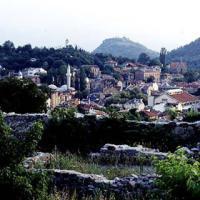
I continued to walk down the main boulevard, past various statues, young people playing hacky-sack, and ancient Roman ruins. (Plovdiv is full of Roman ruins – later that night I walked into what at first looked like an abandoned yard, down a small hill and stood among broken Roman columns from 2000 years ago, stretching into the stars).
I had already walked about two kilometers from the tournament site, when I decided to get a bag of popcorn from a street vendor. As I was standing in line, a small child came up to me with a piece of paper. At first I thought he was going to ask for money, but then I saw that the paper was stationary with pictures of chess pieces. He wanted an autograph. Then I realized I was happy being a chess player again.