Upgrade to Chess.com Premium!

Do We Really Need Old Chess Books?

  • GM Gserper
  • | Apr 18, 2010
  • | 9430 views
  • | 25 comments

I was going to continue my "Openings for Tactical Players" series and write about the Ragozin Defense but had to pause for a moment.  This is my main opening against 1.d4, the opening I've been playing for almost a quarter of a century already, the opening I used against the World's top grandmasters... Heck, I met my future wife by playing this opening (that's a long story).  "Oh memories, light the corners of my mind, misty watercolor memories of the way we were..."

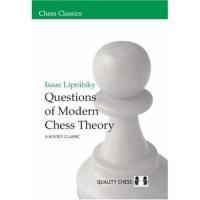
So how did I start playing this wonderful opening? It all started with the Soviet classical book "Questions of Modern Chess Theory" by Isaac Lipnitsky. This is one of the most influential books ever written.  It is enough to mention that a certain Robert James Fischer (who learned Russian to be able to read Russian chess books and magazines!) quoted this book in his own classic "My 60 memorable games", and one of the World's best coaches, Mark Dvoretsky highly praised this book.  The book written in 1956 consisted of two parts.  In the first part Lipnitsky explained methods and philosophy of modern chess in simple and clear language, using very instructive examples.  The second part of the book was devoted to the Ragozin Defense.  Here the author showed how to apply the principles described in the first part of the book to a particular opening. I read the book and got hooked! Even though many lines recommended by Lipnitsky were already obsolete, he managed to share the spirit of the opening. It is almost like when you look at pictures of strangers, trying to not miss any single detail of their faces, sometimes you start thinking that you know them and probably even saw them somewhere.  I had the same feeling after I finished the Book. I felt like the Ragozin Defense was the opening I used to play a long time ago, but somehow forgot about it.  Many years later I was happy to learn that in 2008 Quality Chess decided to translate this classic into English and make it available to the huge English-speaking community . But when the book was actually published I was severely disappointed.  The second part of the book devoted to the Ragozin defense was simply thrown away! Apparently somebody decided that there was no point to print an opening analysis from 1956. I can only quote Julia Roberts from "Pretty Woman" : "Big mistake! Big! Huge!"  Leaving aside the ethical part (after all you don't throw away Mona Lisa from the Louvre because being 500 years old she is... well kinda outdated), I just think it was a huge disservice to the readers.

Today I want to show a game played by Lipnitsky (who was a very strong chessplayer. Chessmetrics.com placed him #12 in the World in 1950 with a rating of 2700!) And of course he played his beloved Ragozin Defense! Try to learn as much as you can from the Master!


 Question #1: How Should Black use his advantage in the development?

Question #2: How should Black continue?
Question #3: Is 22...Qd2 a good move?
Question #4:  How should Black finish his attack?
In conclusion I would like to reiterate my deep belief that the best way to learn openings is to analyze good games played by great chessplayers. This way not only will you improve your general level of chess, but also learn specific opening ideas.  And this is something the publishers of the English translation of the "Questions of Modern Chess Theory" didn't take into account.  Some particular variations can become obsolete or get refuted, but the opening ideas are eternal!  GM Bent Larsen said it best in his book of selected games. Describing one of his biggest chess achievements (Amsterdam 1964), he mentioned that most of the participants were preparing for the tournament researching the latest novelties of GM Boleslavsky (who was one of the best theoreticians of that time), meanwhile Larsen himself was studying games of Greco and Philidor!
So, do we need old chess books?

Comments


  • 8 months ago

    theresalion

    its mate in 2 but good question that our grandmaster missed??

  • 8 months ago

    crossbow

    In diagram no. 2: What's wrong with 23...Rb1! then mate next move? Is this what our old folks said, "prolonging the agony"? I really like your article! XD

  • 16 months ago

    Dimitrije_Mandic

    !

  • 2 years ago

    timlawson

    I also saw the Rb1 move in the second puzzle but the beauty of the illustration is that the technique deployed in the game is a theme which comes up commonly with an intermezzo check... so although not the quickest way to win, it is still instructional in it's own way!

    Some good examples here though I am looking at the budapest gambit myself, having seen a few games on the database so I might treat myelf to a buda book! Yes, books are most relevant... easy to pick up and there's nothing like the feeling of a good old fashioned tome rather than an electronic monster! Computers definitely have their uses though so I'd recommend a good mix!

  • 2 years ago

    jacksmith

    thesexyknight: you did have to use a computer to be sure about a mate in 1 even after seeing it ?! now i think i know where your 2055 ratings came from. i pity them, he who uses computer (or any such way) to make a winning. they never enjoyed chess from soul !

  • 2 years ago

    caco00

    Someone plagearised this article into an Amazon.com's review for the Lipnitsky book....


    Nice article, BTW Smile

  • 2 years ago

    Estragon

    Old openings books can be a treasure trove!  I learned enough German to get through Schwarz and Taimanov's books, which yielded many ideas most players never prepare for. 


    I anxiously await the release of your new CD, "Serper Sings Streisand" . . . Wink

  • 2 years ago

    snits

    Questions of Modern Chess Theory, at least the Quality Chess edition, should be available through amazon.com and other chess book outlets.

    It is a shame they left out part of his original work. I recently got a translation of Botvinnik and Ragozin's book on the 11th USSR Ch, and it didn't contain Botvinnik's writings on how he prepares for competitions like the original Russian edition did.

  • 2 years ago

    nirvana

    nothing taste like the good old wine.How can I get this book.Is it in Amazon?Chess life

  • 2 years ago

    mlewisdmd

    I am sure I am missing something but in puzz #2 isn't  21... Qb6 also a move to consider?  Apologies if I missed something obvious but it seems more effiicient than 23...Rb1

  • 2 years ago

    WGM Natalia_Pogonina

    I have recently read Lipnitsky's book (slightly updated and revised edition), it's indeed great.

  • 2 years ago

    Baron_Zugzwang

    Yeah I bought the book and was gutted when it said that his analysis of the Ragozin/Vienna defence has been cut out. The remainder is a jewel though; it is the key to the accurate understanding of positional chess. Does anybody know where I can get a copy of the missing part of the book?

  • 2 years ago

    SPINUS

    I BELIEVE THAT IN QUESTION 2, 23. ... Rb1! WOULD BE FASTER AND EVEN MORE BEAUTIFUL

  • 2 years ago

    theresalion

    usually you give more than one game when presenting an opening whats different about this opening??

  • 2 years ago

    PAWNAROUND

    I went back to one of my old chess books from the 60's and realized why I was having sooo much difficulty remembering the annotations.... They were different!!

    Thank God for progress!

  • 2 years ago

    FlyingLizard

    Ah! I saw 23. ... Rb1!! a little way off, but then scrolled down to see a lot of other people had too! Good work, guys!

  • 2 years ago

    Jupp53

    In Germany you can buy "Common sense in chess" with cutting out of Lasker's remarks to the Evans Gambit! And Tarrasch "Das Schachspiel" is sold with "actualization" of the opening theory!

    They don't know what they are doing. Frown

  • 2 years ago

    thesexyknight

    Yeah, I definately saw that Rb1 move... I plugged it into a computer. It's definately a mate in 1.

  • 2 years ago

    BishopsFinger

    Question 2: Move 23: Isn't Rb1 faster?

  • 2 years ago

    Dimitrije_Mandic

    Stole it from my mouth, mathijs! Smile

Back to Top

Post your reply: