The Decorous Salomon


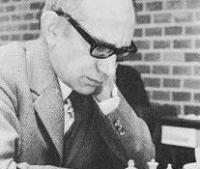
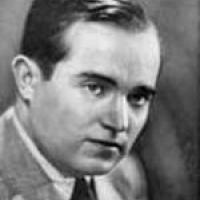
Salomon Flohr was born November 21, 1908 in what is now Ukraine. He lost his parents during World War I and together with his brother was orphaned as a child and relocated to Czechoslovakia, where he learned chess and became a professional chess player. After he settled his residence in Prague, he acquired a reputation as a skilled chessplayer by playing for stakes in many cafés.
After winning the Kautsky Memorial tournaments of 1928 and 1929 held in Prague, he made his international debut at the Rohitsch-Sauerbrunn (Rogaška Slatina) tournament in Slovenia, where he finished second to Akiba Rubinstein. As a chess journalist he began covering the Berlin tournament in 1928, where he also was a prize-winner. From 1931 to 1934 he took first at three Hasting tournaments and the following year he tied with Botvinnik for first at Moscow, ahead of Lasker and Capablanca! And in 1937 Flohr was selected by FIDE as official challenger to Alekhine!
In match play, Flohr had quite good results playing with two of his main rivals for the title of challenger to reigning champion Alexander Alekhine. He drew a match against Euwe in 1932 (+3 =10 -3), and drew against Botvinnik in 1933 (+2 =8 -2).
In the Chess Olympiads, playing every time on board one for his adoptive country, Salo Flohr was simply impressive! He made his debut at Hamburg 1930, scoring a phenomenal 14.5/17 for the silver medal. On home land at Prague 1931, he scored 11/18, and led Czechoslovakia to a team bronze medal. At Folkestone 1933, he made 9/14, helping Czechoslovakia to the team silver, and earning a bronze medal. At Warsaw 1935 he scored an unbeaten 13/17 for the individual gold medal, and Czechoslovakia finished fifth. Then at Stockholm 1937, he scored 12.5/16 for another individual gold medal! In five Olympiads, his total was 60 out of 82, for a fantastic 73 per cent against the top players in the world.
The Second World War and the Nazi invasion of Czechoslovakia killed off any chance he had of winning the world title; the stress of becoming an immigrant for the second time in his life affected his style of play.Flohr fled to the Soviet Union and took Soviet citizenship.
After reaching safety in Moscow, he won Kemeri 1939 with a wonderful score of 12 out of 15, and also won the very strong 1939 Leningrad-Moscow tournament with 12 out of 17. Then he tied for second at Margate 1939 with 6.5 out of 9 behind only Paul Keres, and tied for second at Bournemouth 1939 with 8.5 out of 11, behind only the former World Champion Euwe. But he couldn’t keep his former results against the new generation of Soviet stars which emerged after World War II and dominated the world chess scenery with their sharper styles and innovative openings!
Eventually he withdrew from serious tournaments, but he remained outstanding as a chess journalist until his death in 1983.
Rueben Fine as a psychologist wrote: “Flohr was a hero in Czechoslovakia, where chess was extremely popular. There were Flohr cigars, Flohr collars, Flohr pastries. With this support endangered, Flohr found it impossible to concentrate on his own growth as a chess master. His childhood had left psychic scars which he was unable to eradicate. And so he chose, unconsciously perhaps, the method most suited to keep him near the top to make him feel safe; nothing else mattered.”
FIDE awarded him the International Grandmaster title on its inaugural list in 1950 and the title of International Arbiter in 1963.
Salo Flohr died in Moscow on July 18, 1983.
.