Upgrade to Chess.com Premium!

The Euler's 8x8 magic square

Submitted by Sam_math on Wed, 05/13/2009 at 7:01am.

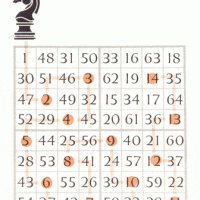
The Euler's 8x8 magic square.

A magic square of order n is an arrangement of n^2 numbers (usually 1, 2, 3...) such that the sum of the numbers in all the rows, columns and big diagonals is a constant.

For example:

An example of a magic square of order 3.

Here the sum of all rows, columns and main diagonals is equal to 15.

This is a very interesting mathematical topic that shows how chess has a big mathematical mistery. Leonard Euler, a very important mathematician, constructed a magic square of order 8, in this square if you put a knight in the 1 you can touch all 64 boxes in consecutive numerical order.

The Euler's 8x8 magic square.

This square solves 2 big problems:

  • To construct a 8x8 magic square.
  • Move a knight in a chessboard visiting all squares 1 and only 1 time.

Conclusion: Math & Chess have many things in common.

» posted in Fun & Trivia
 

Comments:

by MCAbbass - 3 months ago
United Arab Emirates
Member Since: Oct 2011
Member Points: 1

Nice stuff ,actually the set of numbers (natural numbers) also have too much fun imagine if U add to each square (64 squares) in chess board double the the number starting from 1 , at the end U will get this number 1*2^63= 9223,372,036,854,775,808 starting from 1,2,4,8,16,32,64,128 at first row

second raw    256,512,.........

by Tekoa - 16 months ago
Essex England
Member Since: Jul 2009
Member Points: 177

There is one prime number which is even and that is 2.

by lucasp1015 - 18 months ago
new york city United States
Member Since: Jul 2010
Member Points: 3

what the fuck is this pice on crap. I hate fucking black people in the asshole. monkey tits

by zankfrappa - 2 years ago
Virginia United States
Member Since: Nov 2008
Member Points: 5735

I thought for a magic square the diagonals had to add up to the same number as well.  These don't add up like the rows and columns.

by 1stking123 - 2 years ago
Houston United States
Member Since: Jul 2009
Member Points: 15

that is very interesting! i need to show my friends how that works!LaughingLaughingLaughing

by jonatz_elise - 2 years ago
Muntinlupa Philippines
Member Since: Feb 2009
Member Points: 101

That was so cool!! I need to copy that and show it to my classmates!!!

by vitali_10 - 2 years ago
Jerusalem Israel
Member Since: Sep 2007
Member Points: 417

So this idia with the knight probably can be done on every 4nx4n magic square where nэN (n belongs to natural numbers: 1,2,3...)?!

by ratrosie - 2 years ago
Janesville, Wisconsin United States
Member Since: Jun 2009
Member Points: 1

'Mystery' is misspelled, but other than that, great article!

by Marvin2 - 2 years ago
Sydney Australia
Member Since: May 2009
Member Points: 246

cool

by h777 - 2 years ago
Vancouver Canada
Member Since: Nov 2008
Member Points: 15916

cool!

by punkyboy - 2 years ago
Tai Pei Taiwan
Member Since: Jun 2009
Member Points: 387

thats kind of coolLaughing

by shcp - 2 years ago
chicago United States
Member Since: Jan 2009
Member Points: 148

thanks!

by RoyalStraightFlush - 2 years ago
Jakarta Indonesia
Member Since: Apr 2009
Member Points: 641

Good article. Thanks 4 sharing

by razorblade12 - 2 years ago
Herefordshire United Kingdom
Member Since: Dec 2008
Member Points: 1196

except 2 as 2 is a prime, even number :P

by PeterArt - 2 years ago
Luijk Belgium
Member Since: Feb 2009
Member Points: 1000

nice article if there is anything odd it must be primes.
As by nature, a prime number is an odd number Laughing

Check this link here to checkout chess and primenumbers  !

a sample:

29 (a primenumber) is the maximum number of squares a chess bishop can visit if it is only allowed to visit each square once. (Here, "visit" means that squares passed over in a move are also visited.)

Nice might be 499 too it also deals with the knight on the board much like your version but some different things are going on.


Add your comment:

Join Chess.com for free to add your comment! Already a member? Then login now to comment.