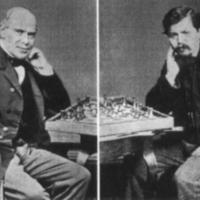
The Godfather of Chess: Wilhelm Steinitz

Submitted by GM Julio_Becerra on Wed, 08/26/2009 at 1:49am.

Part 1: The Austrian Morphy

Wilhelm Steinitz, born in Prague on May 14, 17 or 18, 1835 or 1836! (the date has never been ascertained) was the last of thirteen children in a very poor family and the first acknowledged World Champion of chess. He was recognized as the world's leading player after he defeated Adolf Anderssen in a match in 1866, but it was not until his defeat of Johannes Zukertort twenty years later that he was recognized as the first undisputed world chess champion. Some contemporaries and later writers described him as world champion since 1866, when he won the match against Anderssen.

Steinitz was the first chess player to gain money from his tournament and match victories but he did not make enough to retire comfortably. “Fame, I have already. Now I need the money.” He said.

He completely changed the game as it was played by the romantics, and most likely he was the foundation upon which all modern technique of chess has been built! He started out as a player in the romantic tradition, going all out for sacrifice and combination. Then he developed a series of concepts that made him all but unbeatable during the twenty-eight years that he was the leading player. Steinitz himself wrote: “I was champion of the world for twenty-eight years, because I was twenty years ahead of my time. I played on certain principles, which neither Zukertort nor anyone else of his time understood”. Extraordinary!

“While Morphy was mainly concerned with the open game,” Reti wrote in Master of the Chessboard, “Steinitz endeavored to find the rules and principles underlying the closed positions.” That style involved what he described as “an accumulation of small advantages.”

All of Steinitz's successes up to 1872 inclusive were achieved in the attack-at-all-costs "Romantic" style exemplified by Anderssen. I have selected for this first issue about Steinitz’s approach in chess some positions from his early years, when he was called ‘The Austrian Morphy’!


More combinations from the Godfather:


» posted in Chess Players
« Previous | 1 2 | Next »

Comments:

by chessbibliophile - 3 months ago
Bangalore India
Member Since: May 2009
Member Points: 879

On the final tragedy of Steinitz:


According to Chernev and Reinfeld, his life was a succession of sorrows; he was born a cripple and to a poor family.

To subsist he had to waste the best years of his life playing nonentities in coffeehouses. Continuously he suffered from not being understood and being belittled and he never knew what it was to live without problems. The crowning irony of his life was that he was he dethroned through his students, all of them young, fresh, strong, playing an old man whose spirit was broken through through the tragedies in his family.They took away the last possibility of his earning a living, they won against an old man  who dragged his broken body with canes and crutches but still retained his fierce will of his earlier years. Steintz’s students won because of his experiments and the results of his knowledge.”

Landsberger also edited The Steinitz Papers, a treasure trove of letters and documents. You would find some of the most moving passages here:

http://www.chessville.com/reviews/SteinitzPapers.htm

In his last years Steinitz was a broken man. The successive defeats in world championship matches against Lasker crushed his spirit. Dogged by gout and grinding poverty he struggled to retain his pride and dignity till the end. The man who strove to establish the reign of reason over the chessboard could not find it in the world in which he lived. No wonder, his mind was unhinged.The final drama of his life reminds one of King Lear. The same majesty and the same grief.

May his soul rest in peace.


by chessbibliophile - 3 months ago
Bangalore India
Member Since: May 2009
Member Points: 879

 Dear friends,


I thought we should wait for Part II of this article before further discussion. However, such is the interest in Steinitz and Lasker that quite a few comments have already appeared.

Now about the Lasker-Steinitz Matches:

The Return Match (1896-97) saw the collapse of Steinitz.

But the first match (1894) was a closer affair than the final score (12-7) indicated. Here is an essay on the Match with commentary on the 16th Game. It is a terrifying contest with no holds barred.(http://www.chessville.com/reviews/QCH19993.htm )

I would  also ask you all to take a look at Robert Hübner’s  recent book on this Match, Der Weltmeisterschaftskampf Lasker - Steinitz 1894.The variations offered by Hübner are incredible.Do not be intimidated by the fact that the book is in German. You can follow the analysis in pgn. format.

http://marshtowers.blogspot.com/2009/05/chess-reviews-94.html

No, this match was no cakewalk for Lasker.

by Artemi - 3 months ago
Imus, Cavite Philippines
Member Since: May 2008
Member Points: 132

Don't forget that Lasker met Steinitz in his old age @ 58 years old. He is supposed to be retired. He play the match only in the spirit of sportsmanship.

by Helipacter - 3 months ago
Santiago de Compostela Spain
Member Since: Oct 2008
Member Points: 122

@ shiro_europa thanks, I really shouldn't look at chess games late at night... D'oh!

by chessbibliophile - 3 months ago
Bangalore India
Member Since: May 2009
Member Points: 879

If there was one modern player who followed Steinitz’s principle of accumulation of small advantages, it was Bobby Fischer. His games with Ruy Lopez as White   are an expression of this principle. So are his classic games against  Smyslov, (2nd Round, Interzonal 1970), Petrosian (7th Game, Candidates’ Match 1971) and Spassky (6th Game,World Championship Match 1972).

Even in blitz his play was always logical, following a clear positional plan without tricks and spectacular effects. Let us remember that he won the World Blitz Championship in 1970 ahead of acknowledged masters of  lightnig play like Tal, Petrosian and Korchnoi.

by theinfernalgame - 3 months ago
Denver United States
Member Since: Jul 2009
Member Points: 6

Birdbrain,

True enough, accumulating small advantages in blitz play is not easy or intuitive under the circumstances, so if you don't favor the romantic style you really have to work harder. Blitz lends itself to brashness because the effect of the clock is greatly amplified. A blitz game (more so than in a long game) often comes down to making more trouble for your opponent than he makes for you, and aggressive moves create trouble.

You also highlight another tendency of the non-aggressive player, this kind of play tends get a player into a rut of always thinking defensively. Defensive play can be unimaginative and not-so-interesting to watch. So, it will be interesting to see if the examples from Steinitz later games are less interesting than the ones we saw today from his romantic days. To put it another way, did Steinitz's shift in style make him boring?

by chessbibliophile - 3 months ago
Bangalore India
Member Since: May 2009
Member Points: 879


 About Morphy and Steinitz:

By the time Steinitz met Morphy, the latter had already had retired from chess and become a reclusive figure. Here is an account of their first meeting cited by Sarah Beth (The Batgirl for you) :http://sbchess.sinfree.net/Steinitz_on_Morphy.html

In their subsequent meeting they talked about general things.But Morphy could not bring himself to say much on chess. As Steinitz put it, “…for some reason he felt that chess was no blessing. And who knows, may be he was right.”

 There are two important books on Morphy:

1)Paul Morphy and the Evolution of Chess Theory by Macon Shibut

2)Paul Morphy: A Modern Perspective by Valeri Beim

Check these books for comparison of Morphy and Steinitz.You do not have to be swayed by every opinion in these books. It is good to see an independent interpretation of Steinitz’s games. This is provided by the Russian book, Steinitz byYakov Neishtadt (Ripol Classics, 2004).  


by demetrios18 - 3 months ago
new york United States
Member Since: Nov 2008
Member Points: 500

Steinitz is good, but Lasker is god

; )  Lasker destroyed Steinitz in all his games

by Gary_Seven - 3 months ago
Columbia United States
Member Since: Feb 2009
Member Points: 750

Steinitz said;" Controll the center of board." When you do,you can win, your game. If you don't,you'll lose your game.

by nevin - 3 months ago
Tucson, Arizona United States
Member Since: Apr 2008
Member Points: 68

So many pins on the first game. It almost gives me a headache to watch.

by shiro_europa - 3 months ago
Canada
Member Since: May 2009
Member Points: 130
@ Helipacter > Kh8 pins the queen
by shuttlechess92 - 3 months ago
California United States
Member Since: Jul 2008
Member Points: 1910


Here's the answers! =P
by edwrwelch - 3 months ago
Windsor Ontario Canada
Member Since: Aug 2009
Member Points: 1

To old to be bold is my moto

by deac0n - 3 months ago
Waiouru New Zealand
Member Since: Nov 2008
Member Points: 23

Steintz seen Morphy play and then refused to play him. . .nuff said

by Helipacter - 3 months ago
Santiago de Compostela Spain
Member Since: Oct 2008
Member Points: 122

I'm not sure if I'm being stupid here, but the alternative 20th move for the first game is 20) QxG6?? is followed by ...KH8 which gets a "!", my question is why?

Surely white's follow up move, 21) QH7, is checkmate, no? Or I'm I missing something really easy??

by 201RWB - 3 months ago
Pearl, Mississippi United States
Member Since: Aug 2009
Member Points: 59

I also like the idea of "attack-at-all-costs"!

by BirdBrain - 3 months ago
KY United States
Member Since: Apr 2008
Member Points: 1806

It's hard to accumulate many small advantages in three minute chess, however!  Plus, we see many players that play and train this way are not subtle, like a player with more time would be.  They are trained for quick attacks, and reliable defenses.  And since people are training with computers nowadays, players have to prepare something totally unique.  I have noticed in a lot of the chess games that I have seen recently between top competition that there are a lot more aggressive attacks than I used to see, and aggressive counterattacks as well!  Much more pleasing to watch.

by GrandMasterVaughan - 3 months ago
Las Vegas, Nevada Wales
Member Since: May 2009
Member Points: 57
[COMMENT DELETED]
by theinfernalgame - 3 months ago
Denver United States
Member Since: Jul 2009
Member Points: 6

Attack-at-all-costs is a concise way of summing up the Romantic Era, which seems to be in resurgence today (at least amongst us sub-2000 players). Except today the neo-romantics are less brillant, more brash.

It can be unsettling (especially in blitz) to sit back and endure wave after wave of naked aggression, but if you can keep your head and keep "accumulating small advantages," you can prevail.

Curious how these two disparate styles could come from the same man. Perhaps this is why he spent his last days in an asylum. I look forward to the rest of the series, particularly an exploration of Steinitz's later work.

by chessbibliophile - 3 months ago
Bangalore India
Member Since: May 2009
Member Points: 879


The man who ruled the chess world for 28 years was deservedly called the Bohemian Caesar. It is true that he played some beautiful combinations in his younger days:

http://www.chessville.com/misc/History/WilhelmSteinitzTheUnknownLegacy.htm

 But in later years he played even deeper combinations:

 http://www.chessville.com/reviews/CollectedWorksofWilhelmSteinitz.htm

 Incidentally, there is no longer any dispute on the date of his birth. It’s 14th May, 1836 according to his biographer Kurt Landsberger  who happens to be his great-grand-nephew.

He also points out that Steinitz was one of the thirteen children, and not the last. 

« Previous | 1 2 | Next »

Add your comment:

Join Chess.com for free to add your comment! Already a member? Then login now to comment.