^ Click here to remove ads! ^
You must be logged in to edit this page.

En passant

Last updated on Wed, 03/12/2008 at 6:00pm.

En passant (from French: "in [the pawn's] passing") is a maneuver in chess when a player moves a pawn two squares forward from its starting position, and an opposing pawn could have captured it if it had only moved one square forward. The En passant rule was introduced in 1490.

In this situation, the opposing pawn may, on the immediately subsequent move, capture the pawn as if it had only moved one square forward; the resulting position would then be the same as if the pawn had only moved one square forward and the opposing pawn had captured normally. En passant must be done on the very next turn, or the right to do so is lost. This move can be written as "e.p."

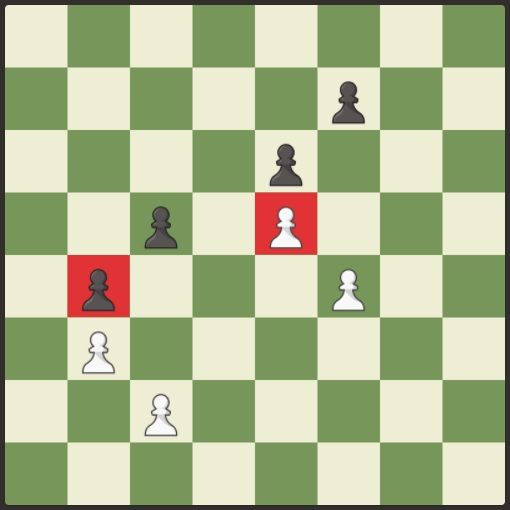
Here is an example:


 In the second diagram, White can NOT capture en passant:


Comments:

by AlecKeen - 12 months ago
Chester, England Ireland
Member Since: Jul 2007
Member Points: 154
This is a throwback to the period before the pawns were allowed to move 2 squares forward on the first move. Before then pawns could only move one square forward at any time, resulting in many boring defensive matches. The 2-square move was introduced to encourage more positive play and quicker development of the pieces. However, some of the more attacking players felt that their opponents were using the move to dodge being captured by the forceful player, already on the 5th rank while the slowcoaches were still on their starting square. Consequently, the en passant rule was introduced to ensure that attacking play did not grow unrewarded when defenders used the 2-square move for a purely defensive purpose. It is analogous to the rule that prevents castling across squares under attack by an opposition piece. 
by Trickster - 12 months ago
Mississauga, ON Canada
Member Since: Aug 2007
Member Points: 232
I think its sort of a Quirky move! no offence!
by sk8erkid - 12 months ago
west palm beach, fl United States
Member Since: Jun 2007
Member Points: 361
kool
by chrisse23 - 11 months ago
London England
Member Since: Aug 2007
Member Points: 4

If I had a penny for every time I got done by this when I first started playing online... I'd have about 8p.

by K3bool - 11 months ago
Riyadh Saudi Arabia
Member Since: Sep 2007
Member Points: 30

it's the first time i hear about it ...i see it but i've not recognized it


by cioly - 11 months ago
iasi Romania
Member Since: Sep 2007
Member Points: 1
i did quite many times...i like it its quite funny:))) especially when the other player doesn't take this move as a possibility
by bosco - 11 months ago
Nauru
Member Since: Sep 2007
Member Points: 172
I once managed to capture 3 pawns with this rule. Its soo cool!
by Darth_Rabidus - 11 months ago
ballarat, vic Australia
Member Since: Sep 2007
Member Points: 82
i have never seen this move before... i will have to use it against a friend of mine... he wont know what hit him!
by archerfish123 - 11 months ago
Hertfordshire United Kingdom
Member Since: Aug 2007
Member Points: 94
I've just been caught out by it!! Never again!!!
by Rael - 10 months ago
Calgary, Alberta Canada
Member Since: Sep 2007
Member Points: 2710


How do you enter the move into Chess.com? 


by 7thllSpirit - 10 months ago
Dubai United Arab Emirates
Member Since: Jul 2007
Member Points: 28

this En passant move cost me a winnning game in a tournament..CryCry

i saw this move when i play chess in my Phone..but thought it is some bug in the software...

never seen it when played agaist other players...waaai...Yell

after my game & knowing the rule, I thought of shooting the one who introduced this rule..hehe 


by Jimmyjoke - 9 months ago
Kent England
Member Since: Nov 2007
Member Points: 8
I just accuesd someone for using a illgeal download doing this move on me. opps!!!!
by mercytononeZ - 8 months ago
New Orleans,LA United States
Member Since: Oct 2007
Member Points: 1728

thats really cool!!


by babatee - 7 months ago
kano Nigeria
Member Since: Dec 2007
Member Points: 23
one is always able to use this towards the end of the game and its always @ winning advantage.
by shadowslayer - 6 months ago
michigan United States
Member Since: Nov 2007
Member Points: 807
thanks for the example otherwise I would be lost
by NotKasparov - 6 months ago
Wilmington, Delaware United States
Member Since: Feb 2008
Member Points: 58
I was playing my friend in chess on a cell phone, and I was going to win easily by using en passant - but the phone's chess program didn't allow this!  I won anyway, but it was much harder.
by 14yearold - 6 months ago
Florida United States
Member Since: Feb 2008
Member Points: 17
not many people know this rule. 4 out of 5 times when i used this move my opponent said that i was cheating lol.
by ednorton - 5 months ago
Madison, Wisconsin United States
Member Since: Mar 2008
Member Points: 27

   You might think of en passant in this way.

   When foot soldiers actually did battle, they attacked diagonally upon their foe. Hence the diagonal pawn capture. In a real battle, a soldier moving forward would always run the the risk of being attacked by another soldier. You couldn't just run by magically. The opponent might let you by...but you never knew. En passant is similar to this analogy. A pawns optional 2 square first move is like trying to run by an opponent. You might get by...you might not.


by dvwork - 5 months ago
Phoenix United States
Member Since: Feb 2008
Member Points: 55
The option to use this is really an advantage in endgame scenarios.  If you are using it early on, it is likely not really to your advantage, to prevent some opposing situation because you lost the tempo, or you aren't playing chess, because the tendency in openings and even early middlegame is that this will leave you with a weakened pawn structure but an advanced pawn that you will have to throw away or find a way to defend.  I may be wrong but this has been my experience.  You don't see it used all that often in master+ games.
by d-huang - 4 months ago
Sydney Australia
Member Since: Apr 2008
Member Points: 17
hmm never seen that before
by Chess_Warrior - 4 months ago
Bayamon B.O Nuevo Puerto Rico
Member Since: Mar 2008
Member Points: 154

Well, I have readed about that in a book called Learn Chess or Call Me An Idiot, it great.


by jammo - 3 months ago
Long Beach United States
Member Since: May 2008
Member Points: 12
What if the defending pawn is already one space out and moves up one more?  Is the rule still valid?  What if the attacking pawn moves up past the defending pawn that is already two spaces out?  Can he do still make the move?
by jammo - 3 months ago
Long Beach United States
Member Since: May 2008
Member Points: 12

What about a bishop that threatens a pawns single space move?


by nimbleswitch - 3 months ago
Idyllwild, California United States
Member Since: Apr 2008
Member Points: 46

Hello, jammo-

You asked three questions: 

 "[1] What if the defending pawn is already one space out and moves up one more? Is the rule still valid? [2] What if the attacking pawn moves up past the defending pawn that is already two spaces out? Can he do still make the move?"

No, to both questions. The defending pawn must have just moved two squares. The attacking pawn (which is on an adjacent file and now on the same rank as the defending pawn that just moved) must capture it diagonally as if it had moved only one square--and the attacking pawn must do so on the very next move or waive the opportunity to capture like that. Neither of your questioned scenarios meets these criteria.

"[3] What about a bishop that threatens a pawn's single space move?"

Ah, this brings up something that has always bugged me. Why is it that only a pawn can capture en passant? If the real purpose of the two-square pawn move rule was to speed up play (as you often read), and if the en passant rule was invented to prevent a purely speed-up rule from being used defensively, then it would seem that it should enable bishops, knights, rooks, queens, and kings to capture on the skipped over square, too. But it doesn't.

Next, try to convince me why an absolutely-pinned piece or pawn should still be able to give check--which it can. That doesn't make sense to me, either. (Boy, would play be different if they changed that rule.)


by Haywire23 - 3 months ago
cuernavaca Mexico
Member Since: May 2008
Member Points: 1
Que?
by chezchamp - 2 months ago
United States
Member Since: Feb 2008
Member Points: 10

I still am confused by En Passant.

How exactly does it work?

I've seen my dad use En Passant, but not on me.

Please will someone reply or send a message to me.


by chezchamp - 2 months ago
United States
Member Since: Feb 2008
Member Points: 10

Oh and, Haywire23 said "Que?"

What the heck does that mean?

Dang Bammit.

Damn Dangit.

Bam Dammit.

Damn Bammit.

Bamd Damnit.


by foogle181987 - 2 months ago
Michigan United States
Member Since: May 2008
Member Points: 1
As for the comment about absolutely pinned pieces giving check, think about it this way, in real time, if, say, a knight, were pinned to defending the king, but, could take the king immediately, then, he's not pinned, because he will kill the opposing king 1/2 move before the, (let's say bishop) that has pinned him would be able to kill his king.  And, since, in the game of chess, the action stops with the loss of the king, the pin is nullified by time.  In short, once your king is dead, it doesn't matter if you can kill the opposing king.  That's like taking turns in a duel...
by chezchamp - 2 months ago
United States
Member Since: Feb 2008
Member Points: 10

now i think i get it more.


by mo78 - 43 days ago
New Hampshire United States
Member Since: Jun 2008
Member Points: 64

I have come across few games where en passant has presented itself..... it is a move that, in my opinion, shuold be thought of very carefully. I have utilized it where the results were detrimental, but have also had some success with it also.  should be used with caution I should say.


by paul211 - 41 days ago
Canada
Member Since: Mar 2008
Member Points: 164

En passant, I am playing with words here as it can also be translated as "by the way" , here is the explanation:

Let's get serious now.

A pawn that has not left it's original position, which is as it is placed before starting a game, a pawn has the privilege to advance two squares instead of one.

The pawn also captures any piece always diagonally.

The "en passant " capture is restricted to a pawn, not any other piece.

The pawn that makes the capture "en passant" is in the file next to the pawn he will capture and he will capture it diagonally, just like any other pawn capture.

The pawn that will be captured "en passant" is on his original square and has not moved yet. For white the pawn that will be captured is on the second rank and for the black on the seventh one.

The pawn that will be captured moves two squares on it's first move.

The pawn that makes the "en passant " move will capture the pawn that has advanced  two square on it's first move.

The "en passant" capture is made on the very next move by the opponent. If you do not make the "en passant" capture after the opponent has moved 2 square from it's original position, you are not allowed to capture it at any later move. Naturally you do not have to capture a pawn " en passant" it is a choice you make based on your position and your intentions according to your plan.

As a guide to determine if I can take a pawn "en passant", I have always used the knigth distance from my opponent to my pawn to determine if I can make the "en passant" capture.

In other words my pawn is on it's starting square and has not moved yet, my opponent pawn on the next file is 2 square away, if I move 2 squares from my initial position then my opponent has the choice to capture my pawn "en passant.

I do realize that the text is redundant, however when someone learns a new move it may be on the second or third explanation that the concept is understood.


In the diagram above the black pawn at c4, note that the black pawn can also be at b4 as it can be on either side, is at knight distance from the white pawn and the white pawn at b2 who has not moved yet is also at a knight distance from the black pawn.


 In the diagram above white has moved two squares from his original position and thus has offered black the option to capture his white pawn "en passant".

 Then if black exercise the option to capture "en passant" he will move his pawn diagonally to the "b" file, just like any other capture that he makes with his pawn, and will end up on the b3 square. He will then remove the white pawn on b4.

Diagram below shows final position after the "en passant" capture.


There you have it.


by ztnook500 - 33 days ago
Cincinnati United States
Member Since: Jun 2008
Member Points: 5

Wasn't this one of the first things taught way back when we started playing?

by lukeyboy_xx - 32 days ago
london England
Member Since: Dec 2007
Member Points: 4052

i always use to be stuck on this!

by srn347 - 12 days ago
California United States
Member Since: Jul 2008
Member Points: 118

If not for the "must be done right away or not at all" rule, laskers trap would be a lot harder to avoid.

Add your comment:

Join Chess.com for free to add your comment! Already a member? Then login now to comment.