
Thanks, I just knew a few basics. I've never heard of people trying to verify equivalence relationships but it sounds like a whole new ordered field :) of jokes to use.
A Basic 5 Minute Crash Course into Basic Topology
Sort:


I think the equivalence-relation view-point is enlightening. Especially if we give an equivalence relation which is easier to imagine than the abstract homeomorphisms.
Consider balloons filled with clay. These can be shaped into many things, but an ordinary balloon filled with clay cannot be formed into a doughnut without puncturing the balloon and spilling clay. It is conceivable, however, that a doughnut shaped balloon could be manufactured, and then filled with clay.
Now such a thing could be formed into the shape of a tea cup.
We can now consider the equivalence relation, R, on balloons filled with clay, given by: (b1, b2) is in R if and only if b1 can be shaped into the shape of b2. (You may verify, that this is an equivalence relation)
After some thought, it may become clear that the only relevant property, to determine if one balloon is related to another, is how many holes the ballon is built with. All balloons with no holes can be formed into spheres, all balloons with two holes can be turned into doughnuts, etc...
So topologists have given this property a name: Genus
And then classified R by saying that (b1, b2) is in R if and only if b1 and b2 have the same genus.
Hope that helps :-)


Jan 24, 2010
0
#24
I feel obliged to complicate the matter by pointing out that what yoff is describing is essentially a concept called "homotopy" or continuous deformation. Basically, if two objects embedded in a space (think 3-dimensional objects in a space such as a room) are such that one can be deformed into the other we say there is a homotopy between them, and this implies that there is a homeomorphism between them, but not vice versa.
A good example is if you have one of yoff's clay-filled balloons that is in the form of knot such as this:

However much you deform this in a 3-dimensional space, you can never unknot it. It takes quite advanced maths to prove this, but most people will probably be rightly convinced that it is true. So this knot is not homotopic to a doughnut within the room.
But this knotted object is homeomorphic to a normal doughnut. The fact that it has one hole is an intrinsic property, which doesn't depend how it is embedded in the space of the room, but the knottedness depends on its relationship to the space in the room.
Here for the class of objects in a room, homeomorphism and homotopy are both equivalence relations but homotopy is stronger, i.e. it breaks things down into smaller classes. To use my rather untopological analogy, if homeomorphism is like being the same make of car, homotopy might be like being the same make and model.
Ah, a good old trefoil.
Jan 27, 2010
0
#26
I'll have to admit that what I said was plain misleading, and not as explanatory as yoff's post. For example a solid sphere embedded in anything is homotopic to a point, but isn't homoeomorphic to it. And a knot embedded in the space of a room is homotopic to a point as well. One has to look instead at the compliment of the knot in the room to make it non-trivial, I believe. [For homotopy equivalence to imply homeomorphism equivalence, you need more conditions]
yoff's more helpful post was really pointing at the fact that for a certain class of things resembling real-world objects (called oriented 2-manifolds), the number of 1 dimensional holes characterises them to within homeomorphism, or to put it another way, so there is one homeomorphism class for each number of holes
0 - the sphere
1 - the surface of a doughnut (or teacup )
2 - the surface of a two-holed pretzel
3 - surface of a 3-holed pretzel
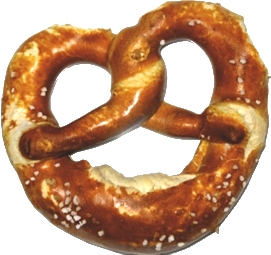
and so on for pretzels with more holes.
Useful link.


Clifford Pickover is a prolific math writer who wrote a book about the Mobius strip, Kline bottles, etc. and it was my introduction way back. You may enjoy it, KJ.

Hey StrangeQuark,
Sorry I havn't been around. Been busy. I am not sure about Topology annoying Lewis Carroll. I would not be very surprised to learn that it did, topology annoys a lot of people. There is a lot of culture within mathematics. There are many subcultures as well based on the discipline being studied and the methodologies used.
Here at my university, people usually fall into one of a few broad catagories. Most consider themselves either Analysts or Algebraists. You see some applied math people running around, a lot of mathematics education people. There are a few that are into combinatorics (which I tend to nickname counting theory). A small few of us are hardcore into topology and/or differential geometry including myself.
My point here is that each of these disciplines approaches mathematics very differently and the cultures sometimes clash. For example, here, Topologists tend to feel that Analysts are super uptight and overly focused on details(One Topologist/Geometer I know says that Analysts are too busy focusing on their epsilons to get the big picture). Analysts tend to see algebraic topologist and sort of goofy and too loose in their rigor(One Analyst I know told me one time that she thought that Topologists just make things up as they go along).
Now, back to Lewis Carroll, he was working on geometry and logic during the late 1800's. This is around the time when Topology was really starting to come to fruition. Henri Poincare is usually regarded as the father of topology as a formal discipline, he lived around this time.
Much of topology is very counter intuitive and sort of hard to wrap ones mind around. It would not surprise me at all to find out that a good portion of the mathematical community at the time didn't like it. After all, if you lack the ability to measure distance, what good is geometry?
Then again, I wonder when Riemann published his work on Riemannian geometry which is just as weird as anything that Poincare came up with....
Sorry for the long winded answer. To be honest I have been on Mathematical Vacation for some time and have not really been thinking about this stuff. Today I return to work.
Hi ho hi ho, its off to abstract algebra I go!

General Topology was my thing, before I un-became a mathematician, became an engineer and hence became forever corrupted with the applied. :P The topology I enjoyed is no numbers, no donuts, only sets of otherwise undefined abstract elements and very general notions of separation. (excepting the many specific applications LOL).
A topological space is a set, together with a nonempty set of subsets of the set that is closed under countable unions and finite intersections.
My favorite application is that in the real numbers, showing that the inverse image of any open set, for a given function, using the usual topology of the real numbers, is sufficient to show the function is continuous. For a lot functions, pages of proof using the usual definition of continuous can be replaced by a few lines.
I have not done topology now for so very many years; far, far too many.

I saw they were bending light using knot theory. I don't understand it but am always interested in listening to the people do!!
Fiber optics.
MikeDoyle wrote:
General Topology was my thing, before I un-became a mathematician, became an engineer and hence became forever corrupted with the applied. :P The topology I enjoyed is no numbers, no donuts, only sets of otherwise undefined abstract elements and very general notions of separation. (excepting the many specific applications LOL).
A topological space is a set, together with a nonempty set of subsets of the set that is closed under countable unions and finite intersections.
My favorite application is that in the real numbers, showing that the inverse image of any open set, for a given function, using the usual topology of the real numbers, is sufficient to show the function is continuous. For a lot functions, pages of proof using the usual definition of continuous can be replaced by a few lines.
I have not done topology now for so very many years; far, far too many.
Sounds like a good excuse to bust out the old Topology books! I love point set topology. When I started my bachelors degree, my goal was to attend graduate school and study number theory and mathematical logic. I ended up getting bored of number theory (although lately I have been interested in it again). My senior year I took both general and algebraic topology. It was love at first sight.
You mention liking point set Topology on the reals, I assume this is in an Analytic context. Have you looked into Differetial Topology? Very interesting stuff. Study that and you will never view the derivative in the same way again.
I took functions of a real variable, complex analysis,measure theory, and 33 credits of other various theoretical math classes in grad school, but that was a really long time ago. One thing that REALLY impressed me about measure theory is that all of probability theory is a special case of measure theory. Lagrange integrals are interesting too in that unlike Riemann integrals, the range is, speaking figuratively, without all the math, "filled with rectangles" instead of the domain, then the limit as they go to infinity is taken, allowing a lot more functions of real variables to be integrated. I've never needed to use any of that as an engineer though, just calculus, differential equations, and a whole HELL of a lot statistics. I did actually once model a netted and distributed communications systems using graph theory (networks and nodes) with Markov chains (different values going to a state than returning from it, etc.), but that was ONCE in 20 years, for THAAD (Theater High Altitude Air Defense System) when it was still in the concept exploration phase.
MikeDoyle wrote:
I took functions of a real variable, complex analysis,measure theory, and 33 credits of other various theoretical math classes in grad school, but that was a really long time ago. One thing that REALLY impressed me about measure theory is that all of probability theory is a special case of measure theory. Lagrange integrals are interesting too in that unlike Riemann integrals, the range is, speaking figuratively, without all the math, "filled with rectangles" instead of the domain, then the limit as they go to infinity is taken, allowing a lot more functions of real variables to be integrated. I've never needed to use any of that as an engineer though, just calculus, differential equations, and a whole HELL of a lot statistics. I did actually once model a netted and distributed communications systems using graph theory (networks and notes) with Markov chains (different values going to a state than returning from it, etc.), but that was ONCE in 20 years, for THAAD (Theater High Altitude Air Defense System) when it was still in the concept exploration phase.
Wow, for an engineer it sounds like you have some pretty good math background. Lesbegue integration is a trip I agree. What excites me about Lebesgue integration is that because you are considering the range so to speak, you can allow your domain to be very weird. Technically speaking you can even integrate over sets in which the idea of continutity does not exist at all- whereas the idea of continuity and Riemann integrablity are very much intertwined. (IE: A function is Riemann Integrabile if and only if it is continous except on a countable number of discontinuties). This idea kind of floors me. You can do integration even between really bizzare abstract spaces. so long as you define a sigma-algebra on their powerset.
Stop me now, I will ramble for hours...
Lebesgue! That's it, not Lagrange! It's been a long time, since 1980. :P
Well, i got a B.S. and M.S. in math first, but had trouble getting a job I liked, and then I found a job with the army where-in they were hiring math and physics majors and sending them to school to get masters in engineering because there was a shortage of engineers, so I took it. I had to agree to work for them for at least 4 more years after that, and by that time I was stuck with dependents, etc., so I got myself locked into engineering, pretty haphazardly. Going straight on for a Ph.D in math and then teaching would have made for a much more enjoyable career I think. :P

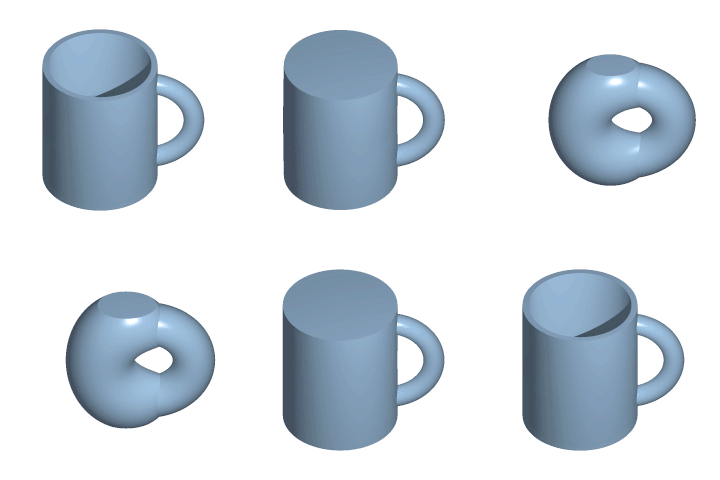
The notion of a doughnut being just like a teacup (and the confusion of people who try to verify this and either break their teeth or burn their laps) is an example of a very general mathematical notion called an Equivalence Relation, which leads to Equivalence Classes. Perhaps a little abstract and dull, but implicitly used every day in every part of mathematics, it must be one of the most fundamental concepts in mathematics.
For non-mathematicians, I'll explain it and how it applies to the topology example.
First some definitions. A relation R is a set of pairs of objects all in some chosen domain, where if (a, b) is one of the pairs we can consider a and b "similar" with respect to R. R has to satisfy 3 conditions which are necessary for it to make sense as an equivalence relation. These are very natural, if you think of the meaning of the word "similar".
(1) for any object a in the domain of R, (a, a) is in R [ any object is similar to itself)
(2) if (a, b) is in R, (b, a) is in R [ i.e. if a is similar to b then b is similar to a ]
(3) if (a, b) and (b, c) are in R, (a, c) is in R [i.e. if a is similar to b and b is similar to c, then a is similar to c]
It turns out, very naturally, that with these definitions, any equivalence relation breaks its domain up into "equivalence classes", which are sets of things all of which are "similar" to each other. [Example: suppose we say two cars are similar if they are made by the same manufacturer. This breaks the domain of cars up into the class of Fords, the class of Hyandais, and so on, all separate from each other.]
Anyhow back to topology. In topology there is a magical thing called a homeomorphism between two objects, which only mathematicians can understand or spell. Two geometric objects are homemorphic if there is a homeomorphism between them. It turns out the relation of a and b being homemorphic is an equivalence relation (think of a and b as being similar to a topologist, who takes no notice of distances), which breaks up the set of geometrical objects into equivalence classes (because it is an equivalence relation), and a doughnut and a teacup are in the same equivalence class, so to a topologist they are considered to be essentially the same.
I wonder if that enlightened anyone who hadn't heard it all before?