
And the opening as white...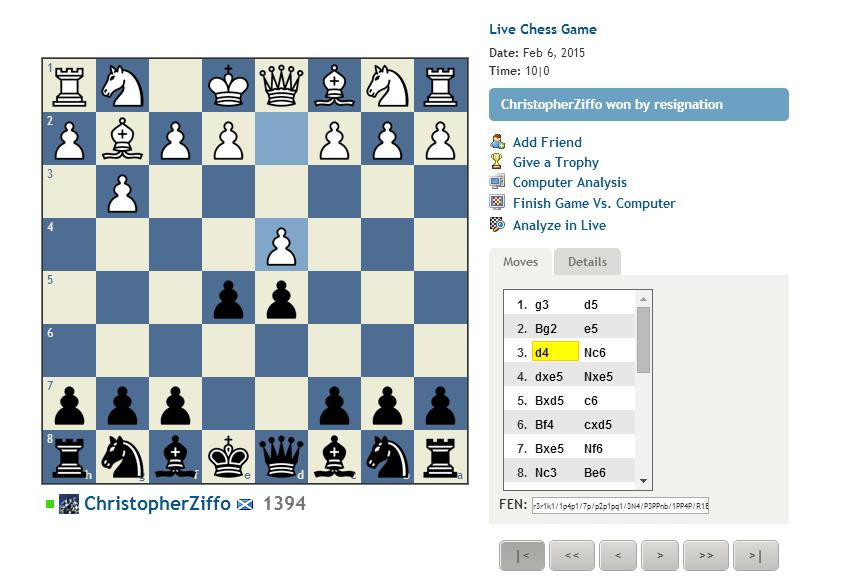
Annoying players who fiancetto early
Sort:

When I say quite good I am speaking relatively. I am around 1400 blitz rating but actually 1600 on the standard (15/10) games. I dont see so much of this b6 and g6 stuff on the standard games


Feb 6, 2015
0
#4
I think either strategy you mentioned is fine. What I'd really like is a *published* reference that says it's good to counter a finachetto with a fianchetto on the opposite side. After much analysis and one comment I read here months ago, that seems to be a well-known strategy, but I've *never* read that in any book.
I *have* seen the pawn chain strategy mentioned in a book, though. Here are some examples of such defenses:
()
1. e4 g6 {Modern Defense.}
2. d4 Bg7
3. c3
()
1. g4 {Grob's Attack.} d5
2. Bg2 c6
Another strategy is to just copy moves, another strategy is to transpose into an opening you like that has a finachetto on the side chosen by White.

There is not a one size fits all answer to this. You have to build up space and be patient. Karpov is usually considered a model player of this type. The final chapter of "Simple Chess" by Stean is useful .....
Ultimately at the very highest level the fianchetto variants fall to well played strategic strangulation. At lower levels the fianchetto defences are effective but IMVHO they set an upper limit on one's potential.

Ziggy_Zugzwang wrote:
There is not a one size fits all answer to this. You have to build up space and be patient. Karpov is usually considered a model player of this type. The final chapter of "Simple Chess" by Stean is useful .....
Ultimately at the very highest level the fianchetto variants fall to well played strategic strangulation. At lower levels the fianchetto defences are effective but IMVHO they set an upper limit on one's potential.
This is a good answer. What I used to do is call them cowards and start flinging my rook pawn down the board as fast as possible.
As I grew as a player and person I developed more sophisticated ways to deal with the cowardchetto.
step one. Do not veiw it as weak or bad, treat it as a sound and respectable way to play. Stop calling it cowardly.
step two, realize that they will be playing a pawn break to disrupt your center. often either e5, c5, or d5 make sure this does not catch you off gaurd
step three. work slowly to increase you advantage, you are not going to checkmate them in 15 just beacuse they played either b6 or g6. What you will do is create good chances for the play to come because your moves were more multifaceted.
each player is different and will play the set ups different there is not a perfect one fits all approach. Using the rook pawn as a lever and exploiting the extra space are some other common themes.
I have even had good practical results in longer games and blitz with
really you have tons of options and the hardest thing is finding a decent one and not going wrong by accidentally giving black good activity, esp for whichever bishop he fianchetto'd
PeskyGnat wrote:
Ah, how true, you have ton of options! now, just to find the right one.
"The style is successful because your opponents are given a wide freedom of choice and often underestimate the position. The style does not restrict the opponents play. This could be both positive and negative. It gives the opponent more of a chance to go wrong." - Suttles
very true

1.e4 g6 isn't bad until you're something like... 2700.
1.e4 b6 is the owen's, and after some study IMO you can get a bigger than usual opening advantage, or at least leave black passive, but there's not a refutation or anything.
1.b3 is the Larsen's, and again with some study you can do fine as black. If you know your opponent is going for e.g. a colle zukertort then both a queen's indian and a king's indian setup are nice. If you study the QID response you can often leave white passive.
1.g3 is completely fine of course.
(When stuck with a passive position, it may be defendable, but there are usually big psychological and technical difficulties.)

A classical setup with knights on c3 and f3 is fine.

PeskyGnat wrote:
Those annoying players..like Duncan Suttles :) seems like he played g3 or g6 in every game by move 2 or 3, and was highly successful with it.
I have a story about Duncan Suttles. In the 1973 US Open in Chicago going into the 12th and last round, one player had 10 points out of 11.
All this player needed was a draw to win the US Open. But he was playing Duncan Suttles. Suttles had Black but would not agree to a draw. Suttles was playing his usual stuff. Many players who had ended with 10 out of 12 were watching the game and rooting for Suttles.
Suttles finally won the game and then there were many who tied for first place with 10 out of 12.
FirebrandX wrote:
leiph18 wrote:
1.b3 is the Larsen's, and again with some study you can do fine as black. If you know your opponent is going for e.g. a colle zukertort then both a queen's indian and a king's indian setup are nice. If you study the QID response you can often leave white passive.
I've been playing the Nimzo-Larsen for years, with transpositions into the Colle-Zuckertort depending on what formation black takes. One thing I do NOT do is allow a King's Indian against it. If I see g6 and Nf6, I snap that knight off, fianchetto on the king side, and expand on the queenside. I've got a very decent score in those lines, usually winning in blitz with it.
Ah, too bad, that's my favorite way to play against it. I've only faced that strategy once at a tournament and I didn't do very well.
Luckily for me he blundered into an equal endgame and then lost in time trouble heh.
For some reason it seems most don't take the knight though.
The line 1. g3 d5 2. Bg2 e5 3. d4?! appear to be a mistake and Black can get a slightly better game with 3. d4 exd4.

the issue is not with how they play, but your inability to cope with it.
Here endeth the lesson


Sep 7, 2017
0
#14
Personally, I just try to grab space and try to dominate the center, not getting too carried away because the finacettoed bishop's purpose is to influence the center and long diagonal. If I can keep it blocked with a center pawn on my 4th rank and an adjacent pawn on the 3rd rank, that often keeps the fiancettoed bishop limited in influence.
If it's a fiancettoed bishop in front of the castled king, I sometimes line up a Queen behind a bishop on the diagonal that can attack the fiancettoed bishop and try to exchange it before launching an attack on the king.

ponz111 wrote:
PeskyGnat wrote:
Those annoying players..like Duncan Suttles :) seems like he played g3 or g6 in every game by move 2 or 3, and was highly successful with it.
I have a story about Duncan Suttles. In the 1973 US Open in Chicago going into the 12th and last round, one player had 10 points out of 11.
All this player needed was a draw to win the US Open. But he was playing Duncan Suttles. Suttles had Black but would not agree to a draw. Suttles was playing his usual stuff. Many players who had ended with 10 out of 12 were watching the game and rooting for Suttles.
Suttles finally won the game and then there were many who tied for first place with 10 out of 12.
I really enjoyed Mr. Suttles' comments in MSN forum for the Kasparov vs. The World game in 1999.
https://en.wikipedia.org/wiki/Kasparov_versus_the_World
ponz111 wrote:
PeskyGnat wrote:
Those annoying players..like Duncan Suttles :) seems like he played g3 or g6 in every game by move 2 or 3, and was highly successful with it.
I have a story about Duncan Suttles. In the 1973 US Open in Chicago going into the 12th and last round, one player had 10 points out of 11.
All this player needed was a draw to win the US Open. But he was playing Duncan Suttles. Suttles had Black but would not agree to a draw. Suttles was playing his usual stuff. Many players who had ended with 10 out of 12 were watching the game and rooting for Suttles.
Suttles finally won the game and then there were many who tied for first place with 10 out of 12.
Here is a thread that gives a bit more info on that game. Apparently Mr. Scuttles needed a win to tie for first place so it makes sense he would not accept an early draw offer:
https://www.chess.com/forum/view/chess-openings/duncan-suttles-and-the-modernrobatsch-defense
What are the best tactics for beating those annoying (but sometimes quite good) players who start the game by pushing either the g or b pawn forward one space and then fiancetto. I see it all the time on blitz. I'll play e4 and they play b6, or sometimes g6 and then get the bishop on the long diagonal. They are not using the king's or queen's indian defence because those are defence against d4. These defences dont seem to be documented very well on the internet. Maybe that's because they are unsound, but for some reason I get caught out by them quite a lot.
Also, there are players who even open as white with g3 and b3.
What's a good strategy? Build a pawn chain on the long diagonal? Or fiancetto my own bishops in a symmetrical style?