
1. Do you even play Chinese Chess?
2. "during the warring states". The states were always warring since forever.
3. It wasn't invented in China. It was inherited from India. It was slightly modified in China.
1. I play Chinese Chess.

1. Do you even play Chinese Chess?
2. "during the warring states". The states were always warring since forever.
3. It wasn't invented in China. It was inherited from India. It was slightly modified in China.
1. I play Chinese Chess.

Chinese chess aka Xiangqi was invented in China but might be influenced by India. Just like English language and it's Latin alphabets.
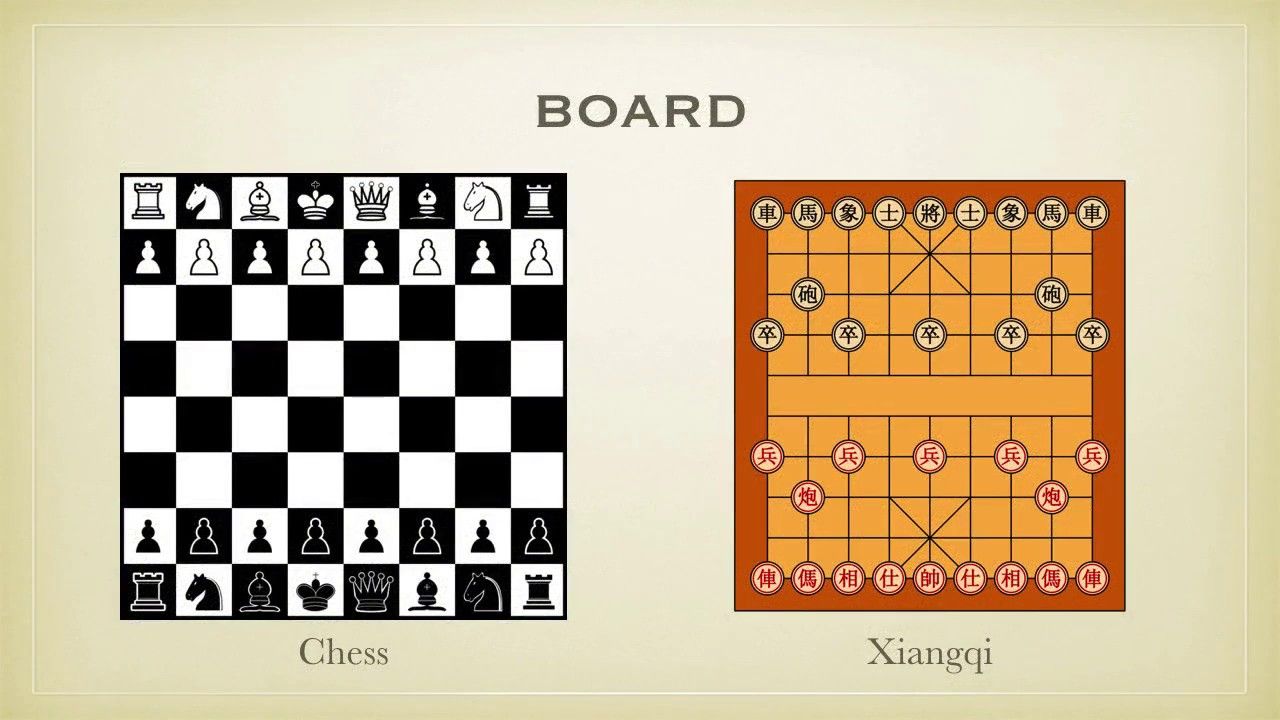 Chess vs Xiangqi
Info about Xiangqi pieces

Chinese chess aka Xiangqi was invented in China but might be influenced by India. Just like English language and it's Latin alphabets.
There's no might about it.
It is 100% descendant of Indian Chess.
It's in the very name 象棋, Elephant Chess. The Chinese do not fight with elephants. Indians fought with elephants.
Info about Xiangqi pieces
That is a modern notation. The Red and Blue are identical.
See the first diagram.
Historically the Red and Blue are not identical. And that's the way I like it.
And the glyph for cannon is wrong.
It should be 炮. The glyph for cannon must have the glyph for "fire" 火 in it.

I wrote a blog sometime ago on this subject. Some of you might enjoy it:
https://www.chess.com/blog/WSama/the-first-ever-chess-match
Info about Xiangqi pieces
That is a modern notation. The Red and Blue are identical.
See the first diagram.
Historically the Red and Blue are not identical. And that's the way I like it.
There is a reason why the pieces are not identical, not symmetrical.
Look at the glyph for "soldier".
卒
It is all nice and neat and symmetrical, like a soldier in uniform.
And the glyph for "warrior"
兵
It is a glyph of 廾 2 hands + holding an axe 斨, 斤. Here is an ancient glyph.
 Uniforms and weaponry are not always symmetric as in more modern days such as the Napoleonic Wars.
The opening battle in Gladiator. "Soldiers" on each sides are different.
The glyph 帥 is best translated as "master" as in the word
師傅 Sifu. It's what Beatrix called her master Pei Mei.
The glyph 將, its ancient form has a glyph of a hand in it.
 It is best translated as "commander", just like in Latin. "man" is hand as in manuscript (hand + written).
帥 + 將 is best translated as "master and commander".
Hmm. That's not implausible. If I'm playing Chinese Chess during lunch and I don't want to get my pieces greasy, I would use chopsticks.
Chinese chess aka Xiangqi was invented in China but might be influenced by India. Just like English language and it's Latin alphabets.
There's no might about it.
It is 100% descendant of Indian Chess.
It's in the very name 象棋, Elephant Chess. The Chinese do not fight with elephants. Indians fought with elephants.
I mentioned Xiangqi might be INFLUENCED(my main point)by Indian chess, while saying it as the descendant of Indian Chess is like saying English language is the descendant of Latin language(which isnt) just because it's heavily influenced by many Latin vocabulary and using alphabets invented by Latin people. 😑We also can't say Japanese language is the descendant of Chinese language just because they also use Chinese characters and many shared Chinese vocabulary. You need to have solid fact like references, being objective and logic, saying it 100% descendant of Indian Chess is too arbitrary, I bet you know cross-cultural society is....😅
Descendant. Like you are a descendant of your parents.
Somebody in China learned Indian Chess. Then changed the rules and made it Chinese Chess.
Like the Vietnamese language is a descendant of Chinese.
Besides, the original definition of "象棋" doesn't mean “Elephant Chess”😂 the Chinese character of 象 has variety of meaning in different contexts such as figure, principle, astronomy, phenomenon, complexion and more. Like you said Chinese do not fight with elephants which is true, hence this even shows that 象棋 Xiangqi was most likely impossible to be interpreted as the "elephant chess" by the Chinese people because "elephant" chess doesn't make sense at all through their daily life.
The only reason why it was named elephant chess in English was due to misinterpretion by just simply translate the 象 into Elephant, which was a much easier object to understand rather than abstract concept of 象(law of nature,figure, astronomy, phenomenon, complexion etc), thus losing the original reference and exact context.

Descendant. Like you are a descendant of your parents.
Somebody in China learned Indian Chess. Then changed the rules and made it Chinese Chess.
Like the Vietnamese language is a descendant of Chinese.
You cant said Vietnamese language is a descendant of Chinese, that can a huge insult towards Vietnamese people😑 You only can said that Vietnamese language is influenced by Chinese language since Vietnamese people have their own language in the first place and because we are close neighbour of sinosphere.
Same applies to Xiangqi, there's already a lot variations of Chinese chess(plural) being played in China in the first place, each of them are quite similar and existed way long than nowdays variant of modern Xiangqi that we know, for instance Weiqi, Wuziqi and Luziqi etc all these different kind of Chinese chess influenced Xiangqi to evolve till now, and of course some pieces of Chaturanga at the same time were also being adopted into the Xiangqi, all these still under research for decades until now. But Xiangqi is definitely not descendant of Indian chess, Chinese doesn't create the whole Xiangqi based on Chaturanga.
Descendant. Like you are a descendant of your parents.
Somebody in China learned Indian Chess. Then changed the rules and made it Chinese Chess.
Like the Vietnamese language is a descendant of Chinese.
You cant said Vietnamese language is a descendant of Chinese, that can a huge insult towards Vietnamese people😑 You only can said that Vietnamese language is influenced by Chinese language since Vietnamese people have their own language in the first place and because we are close neighbour of sinosphere.
It is true. Whether anybody perceive it as an insult is something else.
My name in Vietnamese is Long Quach. Here it is in the original Chinese 龍郭.
Korean language too is a direct descendant of Chinese.

If you need help, please contact our Help and Support team.


chinese chess was invented in china, during the warring states, it was invented by a commander. pieces are placed in sections of board squares. they slide on the lines