✗ NCV ︱ Knightmate

Sort:
Avatar of MrKheese

Timecontrol

3 | 2

Promotion

Bishop, King, Queen, Rook on the 8th rank

Note

Overview: The moveset of the knight and king are swapped. This one simple change has a surprisingly big cascading effect on openings, attacking, defending and endgames.
Avatar of CGA
phpJSLljr.png

Status: Declined

Reason: Our extensive analysis with fairy-stockfish concluded that draws are way overabundant - it is way too easy to attain a draw and in longer time controls, draws are a natural result. The variant is too drawish as a whole, as most endgames are drawn due to pieces being unable to forcibly mate the royal knight.

Avatar of MrKheese

The Royal Horse:

Certainly the knight is harder to checkmate than the standard king? From testing I wouldn't say it is easier or harder than a standard king, just different. Knights and kings can both only move to 8 squares, so conceptually your goal is not any more difficult. There are significant differences however, the knight is much more mobile, able to move from one side of the board to the other much faster than the king, meaning one has to calculate more carefully about their opponents escape plan. This mobility does come with a drawback, the knight does not control any of the squares immediately next to themselves, making it much harder to place your other pieces defensively. For example, a newly castled knight does not defend any of the pawns in front of it, nor the rook at its side. The knight's unique movement also means a knight will never be able to capture the piece that is checking it, another piece will have to capture it or block, or the knight will have to move.

The Non-Royal Kings:

Don't think the royal knight is the bigger of the two changes in this variant. Having two non-royal kings replace the knights also has a big impact on the game. Firstly, the lack of knights makes opening theory quite different, for one example, it is much easier to develop your queen early as a result of not being able to easily attack it with the more mobile knights. Another example is that the kings start the game defending the normally undefended rooks, as well as the traditionally weaker bishop's pawns.

Kings being able to control the same amount of squares as a knight, but in a much smaller range, likely makes their value significantly lower than a bishop, leading to slightly less trading. This low value also makes kings great defensive pieces, able to escort pawns without fear of being checked or captured by a lower value piece.

Their low mobility also makes them common in endgames, (since they're less likely to be traded early,) and as a result, king and pawn endgames with one or two non-royal kings leads to new and interesting tactics and strategies.

Closing Thoughts:

I did not invent this variant, neither did anyone else who has posted about it on chess.com from what I can tell. But I do think it is quite a fun and interesting variant, even with it's seemingly simple changes. I hope everyone gives it a try!

Avatar of LM_WangjiaOfHeilongjiang

Yes, I like this variant.

Avatar of SubSpruce

Yes, this variant is good (for Nelson).

Avatar of MrKheese

Are draws really more significantly more prevalent than standard chess? Genuine question didn't spend much time with the engine with this one as I didn't invent it.

However the second point is definitely false. The number of situations where you can force checkmate is the same as standard chess. Only difference is now lone rook is now a draw while two kings is now a win, (in normal chess two knights is a draw.) So you trade one for one, same number of winnable end-endgames. If you have a single pawn it can be promoted to queen, which is sufficient checkmating material. If you don't have pawns or queen, any combination of two pieces is sufficient to forcibly checkmate. I do not believe that your second point, the way you explained it, is correct.

Avatar of bsrti
MrKheese wrote:

Are draws really more significantly more prevalent than standard chess? Genuine question didn't spend much time with the engine with this one as I didn't invent it.

However the second point is definitely false. The number of situations where you can force checkmate is the same as standard chess. Only difference is now lone rook is now a draw while two kings is now a win, (in normal chess two knights is a draw.) So you trade one for one, same number of winnable end-endgames. If you have a single pawn it can be promoted to queen, which is sufficient checkmating material. If you don't have pawns or queen, any combination of two pieces is sufficient to forcibly checkmate. I do not believe that your second point, the way you explained it, is correct.

Our extremely in-depth analysis revealed that a rook cannot force a mate and a king cannot force a checkmate as well. Rook mates are amongst the most common checkmates in chess, here they are impossible. In regular chess KNNvKP still can force a mate in chess in many cases and in most cases it is possible to keep the extra pawn, so this is not 1-for-1, this is 1-for-0.

Bishop mate is impossible just as in chess. It isn't about just lone knight versus pieces mates, rook can force perpetual check if there are pawns on the board as well and the royal is well-placed, king and knight can hold multiple passed pawns, and same and same-colored bishops with pawns are usually drawn as well with very accurate play from the defender. 

We've analyzed every such endgame extensively with the engine.

Avatar of MrKheese

@bsrti Sorry I misunderstood, endgames and pieces checkmates in the same sentence confused me, but my point about 1-for-1 was in reference to:

Regular chess: One rook is win. This variant: One rook is draw. 1-for-0

Regular chess: Two knights is draw. This variant: Two kings is win. 0-for-1 

And all others remain the same. (E.g. one bishop is draw in both, one queen in win in both, a bishop and a rook is win in both.) Therefore it is even between the two gamemodes in no pawns vs. only royal situations. Thus 1-for-1 overall. Which is what I was referring to originally.

======

I am still interested in answering the question about if there are significantly more drawing situations than regular chess. Further, certainly most of these draws are not trivially easy to find. I am sure any engine can hold several more endgames than what any person might be expected to do.

And do these situations not balance themselves somewhat? One common endgame I can think of that is much easier to win is single pawn. Normally you need all this nonsense with your king in front of the pawn, opposition and the like. But here, pawn can push itself to victory, only occasionally making waiting moves with your own knight.

=====

How are most of the draws easily obtained? Are they mostly perpetuals? Or does the engine just not like having fun and repeats moves constantly? I do remember having a game where my horse was nearly perpetualed around by my opponents queen when I was up a rook, but with careful maneuvering, and far ahead of time considering where I wanted the knight to end up, I was able to position everything to where I could get a spare move in and defend myself.

I don't think drawishness alone is enough to write any variant off, (especially when compared to standard chess drawishness.) I would suspect a lot of these perpetual situations come from playing this variant like regular chess, defending knight as if it were a king. Does the engine run into a lot of perpetuals when it plays itself from the starting position? Or did you have humans play into the game a bit and then look at engine lines along the way.

Currently what matters most is that people enjoy playing it? (Variant has been around for 51 years, as well this post seemed to get more positive responses than the average one here.)

I am interested in finding out more information about what your problems with it are to perhaps see if a small, yet impactful improvement can be made.

I appreciate all the work you all do moderating this forum and investigating new variants.

Warm wishes,

MrKheese

Avatar of bsrti

@MrKheese thank you for your detailed response and feedback, we're always happy to hear such a constructive criticism that we rarely get!

MrKheese wrote:

How are most of the draws easily obtained? Are they mostly perpetuals? Or does the engine just not like having fun and repeats moves constantly?

In fact you're right, many drawn endgames are just perpetual checks and perpetual chases, the engines just do not prefer giving up a draw over a disadvantage that is hard to hold to a draw - I can testify that holding the draws isn't really easy as a human against the engine, but it is possible to get a draw against fairy-stockfish as white for sure, especially in blitz time controls as most games require a very precise technique in order to not lose any advantage. 

1. d4 d5 2. e3 c6 3. c4 Bf5 4. cxd5 Qxd5 5. Qb3 Qa5+ 6. Qc3 Qxc3+ 7. bxc3 h5 8. Bd3 Bxd3 9. Kxd3 Mc7 10. Mc2 e5 11. Bd2 e4+ 12. Ke1 f5 13. f3 Mf7 14. Mf2 g5 15. c4 Be7 16. Rf1 Kg7 17. fxe4 fxe4 18. Rb1 Rad8 19. g3 Me6 20. Mg2 Rhf8 21. Rxf8 Rxf8 22. Mc3 g4 23. Kc2 Rf7 24. Rf1 Rxf1 25. Mxf1 Kf5

Take a look at the game above of Knightmate, with fairy-sf given 200ms of analysis and me thinking around 2-10s each move, though usually around 2s. We see an endgame that any player sensible enough can draw, because if black avoids trades they get into a disadvantage. Let's say that with 10x time handicap as here, no titled player can even nearly come to a draw against stockfish as it is still much stronger in regular chess, here, I, not an expert at this game, can get a drawn endgame against fairy-stockfish with enough practice. No titled player can ever closely get an equal match after middlegame in 3+2 with stockfish being given 200ms per move. That said this variant is much, much more drawish than chess. I'm nowhere near titled level at this variant, yet I still can draw sometimes.

MrKheese wrote:

Normally you need all this nonsense with your king in front of the pawn, opposition and the like. But here, pawn can push itself to victory, only occasionally making waiting moves with your own knight.

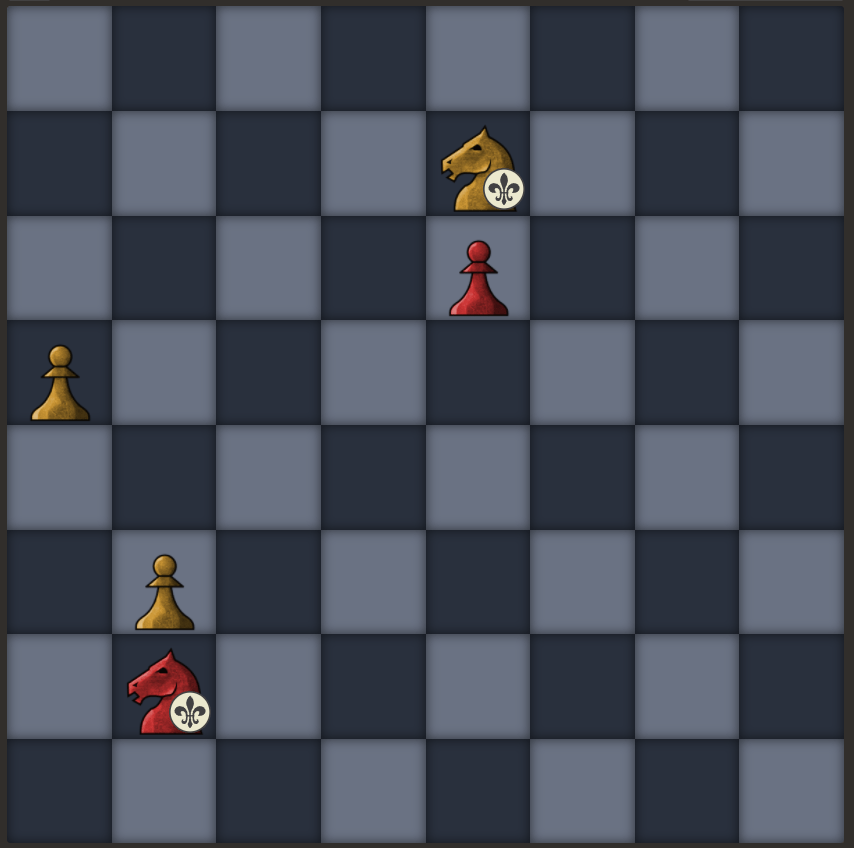
Here this is even better: if the defending color has the move tempo advantage, you can never force them to move away and you can never push a pawn safely, so this is equal - knights are unable to lose a tempo unlike king can. However, in chess, KPvK is rather uncommon - KPPPvKPP is much more common, so is KPPvKP, especially at higher levels. Let's take a look at:

Knight can hold doubled pawns, while doubled pawns in chess are usually won even if the king is in front of square, and knight can hold two files of pawns as well. So the pawn endgames here are much more drawish for PPvP is a classical scenario that occurs quite commonly.


Now, regarding the strictness of our requirements: long time ago we've had requirements like "if it's fun and fair, accept". However we ended up having 120+ variants listed and due to their sheer number absolutely no variant could ever be played, and players would've never known of these variants. We've had to delete a ton of variants as to keep the list from growing into 200+ variants, and most of them got deleted quickly after being accepted. Hence we started to gradually inure the accepting requirements till the point the requirements were strict enough to filter out all but the most thought-out, near-flawless and well-made variants.