
martinchess1 wrote:
i think the pieces look fantastic, functionality aside.
Thanks, keep an eye on this and share your comments, please!

i think the pieces look fantastic, functionality aside.
Thanks, keep an eye on this and share your comments, please!
The Bottom Cap
There should be a smooth interaction between the board’s surface and the pieces. To get around this, we are looking at different materials to cover the bottom part of each piece. The aspects I want to solve are:
After searching for similar problems and how friction, heating, wearing, etc. were solved...right away I knew the materials to test would be: HPTFE, PTFE (Teflon), felt, silk and the looped female side used on velcro.

On the board’s side, the veneer surface is covered with Epoxy varnish, because it’s the most resistant treatment I could find to protect the wood without losing its natural qualities.

Tavo helped me to build a small jig to test all these materials. It consists of a magnet arm directly connected to a stepper motor that drags a piece over a small veneered board (15cm x 15cm).

The jig drags the piece 5cm per movement and it reaches over 85,000 movements per day. We did the maths and this way we can emulate 4 years of use in only 3 days!!!

We are still not sure about which material should be the selected one, all of them presented different issues regarding wearing and ageing so we are still looking for new ones to test.

Some of you recommended some materials in the comments, we already ordered samples of them and I’ll let you know how they work. Any other materials you think we can test?
I’ll leave our discord server if you would like to chat about this project: https://bit.ly/3emyBWy
And my YouTube channel in which I upload progress and test videos: https://bit.ly/3w32wcf

Any link where I can follow some of your projects? As you mention, it's very interesting how people resolve different problems, I think is pure inspiration! "
yes, I've made two projects related to chess, one chess clock (in fact two) and I shared it on tinkercad : https://www.tinkercad.com/things/8Zuc0nLQOpG-rellotge-escacs-jac-mat/editel
And I made my own electronic chessboard. It’s not finished, while I was ttempting to make the circuit board, after eight attempts, I left the project on standby because there was no way to do it. It was just exasperating, now, ten months later, I ordered the PCB and will continue as soon as it arrives.
https://jacmatchessboard.blogspot.com/p/home.html
All my other projects are not related to chess.
Any link where I can follow some of your projects? As you mention, it's very interesting how people resolve different problems; I think is pure inspiration! "
yes, I've made two projects related to chess, one chess clock (in fact two) and I shared it on tinkercad : https://www.tinkercad.com/things/8Zuc0nLQOpG-rellotge-escacs-jac-mat/editel
And I made my own electronic chessboard. It’s not finished, while I was ttempting to make the circuit board, after eight attempts, I left the project on standby because there was no way to do it. It was just exasperating, now, ten months later, I ordered the PCB and will continue as soon as it arrives.
https://jacmatchessboard.blogspot.com/p/home.html
All my other projects are not related to chess.
Both are pretty cool projects; I also have some other projects. Once I finish this one, I will start sharing the other ones.
Modern & Staunton Style
As I said in a previous post, I wanted to redesign every piece to meet my expectations of a quality chess set. It is not only about aesthetics but adding technical specs to the pieces is necessary so they can work perfectly in conjunction with the magnet arm.
Once the components for each piece were decided (wood, magnet, ring), I took the liberty of designing a second version for the chess set.

You already saw the pieces with the modern style, but I think that a good old Staunton style won’t do any harm ;)
There are two main principles that the shape of the pieces should follow:
The first one is that the diameter of the base should be less than half the length of each square for all the pieces.

This prevents collisions between the pieces when they move between each other.

The second one is related to height. The King’s height is 3,38”, which is the minimum established by the US Chess Federation, and the Pawn is 2”.

Then, if you arrange the pieces by the traditional height order and trace a line from the top of the King to the top of the Pawn, the top of every piece between King and Pawn touches this line. I applied this concept to both modern and Staunton versions.
When I started working on the design of the pieces, my first approach was with the modern style. This set is shaped geometrically but also is easily recognizable. My approach with this design is to take the timeless essence of chess into a contemporary look by using simple geometric subtractions from a simple cylinder.

The modern set was effortless to model in CAD, contrary to the Staunton one, which has a lot more detail to distinguish itself from the modern set. The horse, for example, has a more organic shape.

Once the right proportion for each piece is defined, I started working on the 3D models to print prototypes. I prefer this method for shapes and volumes because they come out fast and with enough detail to make decisions.

Once I was happy with every piece, I started working in the CNC program. The first step is to test the CNC prototypes using a soft material; I usually use polystyrene foam.
When all the programs run well on the soft material, I started the machining in wood. For the white pieces, I used maple wood and machiche wood for the black ones.
After the pieces were machined, I gave them a finish by sanding them to get a smooth surface, and then I applied Rubio Invisible for the white pieces and Rubio Pure for the black ones. These finishes are mono coats, so they are effortless to apply.
I can’t decide which design is my favourite and the work put into each set was definitely worth it. Which one do you prefer?

I’ll leave our discord server if you would like to chat about this project or leave any suggestions: https://bit.ly/3emyBWy
And my YouTube channel in which I upload progress and test videos: https://bit.ly/3w32wcf

if you're prepared to sell one of the modern sets i would be interested in buying it.
it should be weighted but not necessarily functional on the automatic board.
it's beautiful.
have you considered a plastic version? perhaps being adventurous with dark pieces.
Very nice set Carlos! I like it more than the modern one. It looks like a professional board and set.
The Automated Board 01
Hi there! I believe naming “automatic chessboard” is not so appealing so I decided to name it: Phantom. Even less appealing is to keep Phantom just to myself, so I decided to launch a Kickstarter campaign as recommended by some of you!
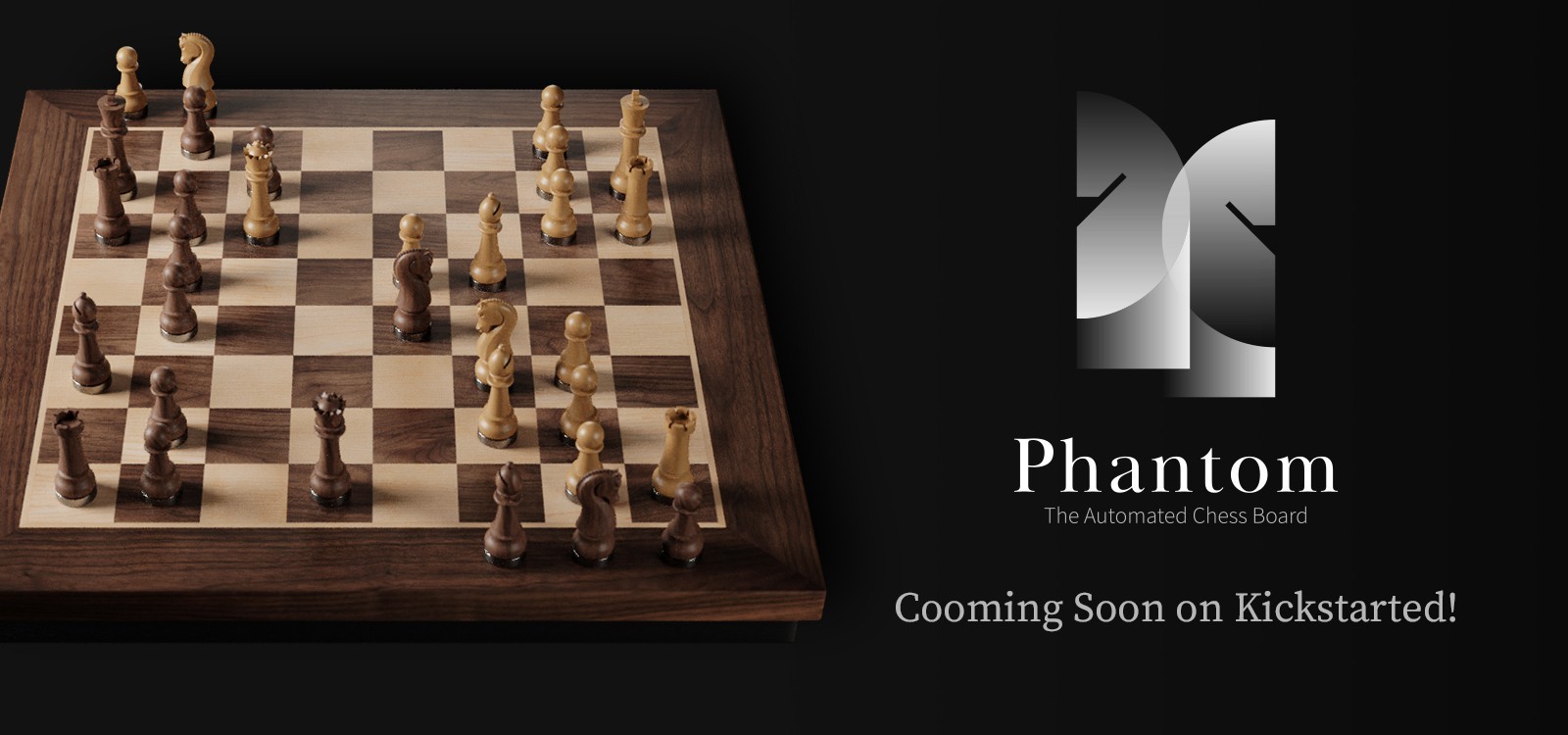
During the last months, I have been sharing the development process and improvements made to the board week by week and got to the conclusion to close the first version to decide the following steps to improve it.
The next step is to be sure all systems are working perfectly fine together before starting important changes. The hardware of the first prototype is conformed by the Scara mechanism, hall effect sensors array, mecha-magnet and 3 microcontrollers running all the features.
I’ll share with you all the files up to this version so you can build your own Phantom Chess, in the files section you will find everything you need: the assembly and 3D model files for each system
-The case is constructed by an aluminium composite sheet with wood veneer for the board surface, and aluminium exterior frame to add support, MDF interior to hold the electronics and an aluminium composite sheet as the bottom plate.

-Under the wood veneer + composite surface the sensor array it’s placed to detect the position of each piece and it is composed of five hundred SS39E hall-effect sensors interconnected with an HC4067 multiplexor.

Tavo developed a three stage software that controls all the features:
The main program is embedded into an ESP32 microcontroller. This software controls the motors and runs the calibration system to spatially the mecha-magnet.
The second program read each hall-effect sensor to detect the pieces positions. I’m leaving you the code that controls the mecha-magnet here. Through an encoder, it detects the up and down positions and uses this data to control the motors that elevate the magnet with PID control. All this software is embedded into an Arduino Nano
The third program focuses on connectivity. Through an Arduino Nano 33 IoT we communicate with the Lichess server to send commands as: start game, select adversary, game info and piece movements.
-Each time you move a piece on the physical board, the Nano 33 IoT sends this information to the Lichess server to be reflected in the digital game; it works the same way each time the opponent makes a move on the Lichess game, the move is sent to the board through the same connection.
-The three microcontroller system is interconnected through an i2c protocol. The ESP32 is the master that controls the Arduino Nano and the Nano 33 IoT.

Files, schematics and further instructions are in our Github repository. Take a look at them and let me know your comments for improvements or questions to start building your own e-board! https://github.com/carlosPendass/CAD-Mechanics


I’ll leave our discord server if you need further information from me and to chat about chess: https://bit.ly/3emyBWy
And my YouTube channel in which I upload progress and test videos: https://bit.ly/3w32wcf
Now I’m also on instagram! https://www.instagram.com/phantom_chess/
Simply amazing, it looks better than square off! Congratulations Carlos. habeis hecho un trabajo increhíble!

This is an incredible achievement. Congrats and thank you for posting!
May I suggest you consider a name change before it proceeds much further? I'm not sure if you're aware, there has already been a self-moving chess set called "Phantom".

Cool
good job 
Hi everyone!! I´m very happy to announce that the Kickstarter campaign is live now!! You can check it out at the link below!!
https://www.kickstarter.com/projects/wondersubstance/phantom-the-most-advanced-chess-board-in-the-world?ref=a3d8o6


Much better than Square Off ! Congratulations !

Amazing job, really impressive Kickstarter! Makes Square-Off look like something from another decade 😜
You should post the Kickstarter as a new topic in the General Chess forum where there's much more traffic. Also, I didn't see any information about specific website compatibility, is it to be assumed that it can be used with chess.com? I'm sure people will want to know about that, and also the other (Li) website.
Simply amazing, it looks better than square off! Congratulations Carlos. habeis hecho un trabajo increhíble!
Muchas gracias! thanks for being around!
Much better than Square Off ! Congratulations !
Thanks! you are from Mexico too?
Cool
good job
Thank you! good to have you around
Amazing job, really impressive Kickstarter! Makes Square-Off look like something from another decade 😜
You should post the Kickstarter as a new topic in the General Chess forum where there's much more traffic. Also, I didn't see any information about specific website compatibility, is it to be assumed that it can be used with chess.com? I'm sure people will want to know about that, and also the other (Li) website.
That's a great advice! I'll publish over there!
This is an incredible achievement. Congrats and thank you for posting!
May I suggest you consider a name change before it proceeds much further? I'm not sure if you're aware, there has already been a self-moving chess set called "Phantom".
Thanks! and yes, I know about "Phantom Force" and I'm not too worried about it since its been out of the market for many years now

Love to follow the progress, thanks for taking the time to write this detailed posts, it is very interesting how other people make a search and investigate to start a project from zero, and see what solutions they finally found. I'm always on this type of headaches as I used (and still use) to make inventions of all kind of matters
Any link where I can follow some of your projects? As you mention, it's very interesting how people resolve different problems, I think is pure inspiration!