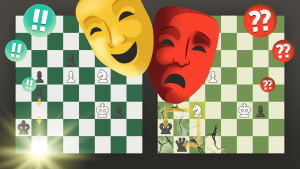
Back in 1996, GM Garry Kasparov won 4-2 in a match versus the Deep Blue supercomputer. It turned out to be the last convincing human victory over an artificial chess player. The very next year, Deep Blue took revenge 3.5-2.5, and pretty soon match...

Chess Played Quick (CPQ), Chess.com's series of events where top chess streamers complete bounties for prizes, is back for another edition!
Chess Played Quick—BlitzChamps Hyper Bullet Arena will take place on May 20 at 1:30 p.m. ET / 19:30...

Has someone ever crushed you with the Jobava London? Thwarted your plans using the Caro-Kann defense? There's a chance that this is the man responsible for teaching them.
IM Alex Banzea has many accolades: Romanian U-18 champion, recipient of th...

Chess.com is thrilled to launch the Indian Streamer Program. To help grow the chess streaming ecosystem in India, we offer a number of benefits to chess streamers of all skill levels who want to get involved on YouTube, Twitch and other streaming ...

Chess.com started 17 years ago, in May 2007—just two years after the first YouTube video was published and the first Reddit thread was created. A lot has changed since then, but one thing remains the same: Chess.com has the most wonderful co...

Chess can sometimes be controversial, but some things about our beloved game are just true. While I may not be the best or most experienced player out there, I dare you to disagree with any of my hot takes:
Stalemate Being A Draw Is Awesome
C...
IM Novak Cabarkapa is an international master from Serbia with two GM norms under his belt. He has trained students of all ages and skill levels, and is available for regular lessons as well as training games. In this article, he shares some of hi...
When was the last time you read human-only annotations to a chess game, with zero input from artificial intelligence? Have you ever wondered how a human grandmaster's understanding stacks up next to Chess.com's Game Review, and vice versa?
For t...
May's monthly update is here and we're recapping the Candidates Tournament, hooking the world's number one player up to a lie detector, and highlighting some of the chess world's true artists.
Also, a much-requested dashboard for following event...
Losing is no fun! Unfortunately, all chess players end up in lost positions sometimes. The best ones know how to escape as often as possible and steal draws and wins from busted positions. Here are the techniques you need to know to be a chess Hou...
Chess has often been described as a mix of sport, art and science. This laconic definition long ago became an axiom for many generations of chess players. However, in the last 20 years or so, things changed dramatically. Yes, it is still sport; ju...
There's no way around it—every chess game starts with the opening. These first few moves are crucial to determining how the rest of the game will go. Because of this, learning how to play the opening well can drastically improve your results...
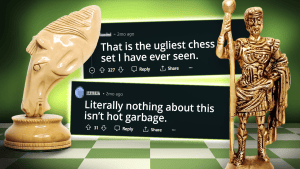
I would like to start this article with a warning: what you are about to see cannot be unseen. I'll understand if you click away right now. But if you're brave enough to power through this, get ready to see the nine most awful chess sets you've ev...
What makes a photo "iconic" and not simply interesting or even outstanding? If you find that a difficult question to answer, you are not alone. The two leading dictionaries in the world can't exactly agree either.
Merriam-Webster: iconic, ...
“Liar, liar, pants on fire!”
The seams of world number one GM Magnus Carlsen’s cream khakis set ablaze. He and chess commentator GM David Howell are brought together to rekindle the flame of this fun lie detector series. Last t...
It's evening in Romania, and WFM Maria Yugina and GM Mihail Marin are sitting on the couch at home for our interview. Their rescue dog, Foxy, bounces around the room, playing around and chasing her own tail, at one point disconnecting the camera a...
I still remember my childhood evenings, watching Searching for Bobby Fischer over and over, the script becoming nearly a manual for my chess pursuits. Even in the mornings before venturing to my earliest scholastic tournaments, I found inspiration...
With two IM norms under his belt and over a decade of chess-teaching experience, FM Michel Coto Mederos is well-versed in coaching students online and in person. Some of his young pupils have even become national champions in their age categories,...
Established veterans face a new generation of up-and-coming talent in the Candidates Tournament, with three contenders under the age of 21. Meanwhile, teenagers continue to set new records and break the boundaries of what we thought was possible. ...
Last month marked 88th birthday of GM Eduard Gufeld, who was born March 19, 1936 in Kyiv, Ukraine. Even though he died over 20 years ago in 2002, he is well-remembered for his entertaining style of play and strong sense of humor. Among many pictur...
The games begin on Thursday, April 4, 2024, for the FIDE Candidates Tournament and FIDE Women's Candidates Tournament! They are being held simultaneously in Toronto, Canada.
This article has all the information you need to watch, follow, a...
Many chess players dream of someday becoming world champion. It's a long and difficult journey to get there. You need to play amazing chess, but you also need to know how to qualify and the steps to take along the way. In case you want to become t...
Chess Played Quick (CPQ), Chess.com's series of events where top chess streamers complete bounties for prizes, is back for another edition!
Chess Played Quick - Doubles (Bughouse) Edition 2024 happens on April 8 at 12 p.m. ET / 18:00 CET / 9:30 ...
An exciting Women's Candidates Tournament is ahead of us! With a field of past women's world champions, women's world championship challengers, and promising young talents, this is poised to be a great event to watch.
Eight of the stronges...
The Candidates Tournament is quickly approaching, and this will be an... interesting one. Eight of the strongest players in the world will vie for a chance to play against the mostly missing world champion, GM Ding Liren. The Chinese player had a ...