

2024/04/26 DPA: "On The Menu: Skewer Or Checkmate?"


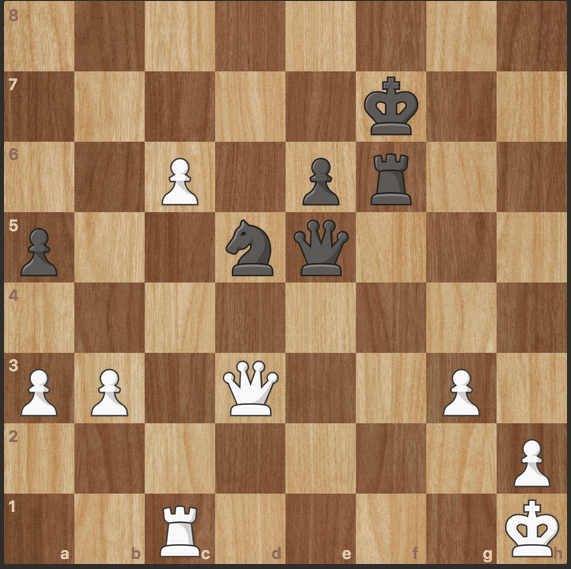
White to move.
White is down a piece but has a dangerous passed pawn on the 6th rank. The puzzle will likely be about White's attempt to promote and Black's attempt to stop promotion.
1. c7 is premature, as the c7 square is defended only once but attacked twice.
Black also has checkmate threats but they will take several moves. Black also has no useful checks, which gives White time to set up a plan.
1. Qh7+ seems reasonable: it gains a tempo, forces the King to the back rank where checkmate is possible if White can promote, and adds a second defender to c7.
1. ... Ke8 is a mistake, due to 2. Qd7+, which maintains White's 2nd defender of c7 but also adds a 2nd defender of c8, the promotion square.
1. ... Kf8. 2. Qd7 now does not come with check so maybe there is a better move.
2. c7 ["Push 'em, baby!", GM Seirawan was fond of saying about passed pawns].
White must be careful of leaving the b1-h7 diagonal because that would allow ... Qe4+ Kg1 Qe3+ with at least a perpetual check. Maybe he can even get in ... Nf4 [threatening # on g2] gxf4 which opens up the g file for the Rook.
2. ... Nb6.
At this point, 3. c8(=Q)+ probably isn't the solution. Yes, it does require Black to sac his Knight but now White is up 3 pawns [2 of them passed] but is this enough?
But I missed something: 3. ... Nxc8 4. Rxc8#.
Does Black have a better second move?
Black could sac the Rook with 2. ... Rf1+ but to what end?
Black could sac the Knight immediately rather than wait for promotion: 2. ... Nxc7 3. Rxc7 Qe1+ 4. Kg2 Qe1#. Not so good for White.
Can White Intermezzo ["in-between" move] something? After 2. ... Nxc7 3. Qh8+ Ke7 4. Qg7+ Kd8 but now Black has another defender for the Knight; White definitely doesn't want this.
Any check by the Queen means also losing control of c7.
White could recapture with the Queen instead of the Rook, thus preventing any ... Qf1# ideas. But this gives Black time to gain a perpetual check, at minimum.
I thought I saw a skewer if the Black Queen was on c7 but Black could reach d8 via e7 to protect the Queen.
White does not want to give Black the chance to play ... Nc7, blockading the pawn on c6 [teachings of Nimzovich] so a setup move for move 1 doesn't appear good.
1. Rc5, pinning the Knight, allows 1. ... Qe1+, which looks uncomfortable.
I just noticed a key point: 3. Qh8+ Ke7 [trying to reach the Knight] 4. Qg7+ and the Rook cannot block as it's pinned to the Queen.
But Black can move 4. ... Kd8.
Could there be a pin on the f file? Could the c pawn be a decoy to get the Knight away from d5 where it protects f6?
Also, if White pushes immediately, we end up with the same position after 1. c7 Nxc7 2. Qh7+ Kf8.
Since a puzzle cannot have multiple solutions for the solver, something is likely wrong with this idea or I'm missing something in either line.
For example, 1. c7 Nxc7 2. Qd7+ allows Black to escape to g6. Yes, White can win the Knight but now his flank is unprotected.
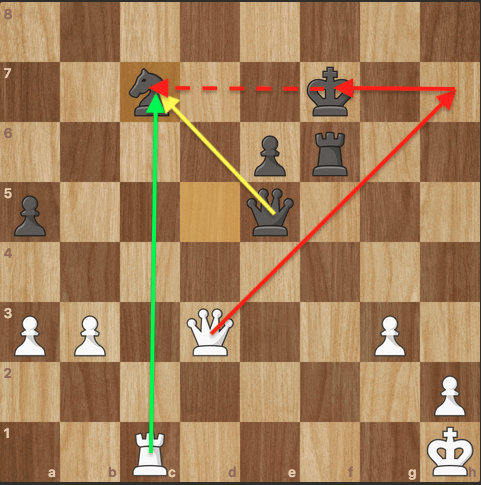
1. c7 Nxc7 2. Rxc7+ Qxc7 3. Qh7+, skewering the King.
The key is the Rook capture comes with check and thus no chance for Black to play 2. ... Qe1+.
Black will want to avoid this so he won't recapture with the Queen. And remember: the d file is now open for the White Queen now that the Knight is gone.
- 2. ... Kg8 3. Qh7+ Kf8 4. Rc8#
- 2. ... Ke8 3. Qd7+ Kf8 4. Rc8#
- 2. ... Kf8 3. Qd8#
Since avoiding 2. ... Qxc7 ends in checkmate, the solution chose the skewer.
.
My problem was that, even though I was able to mentally subtract the Knight from d5 when it came to the Rook capture, I wasn't doing so when it came to the Queen moving to d7; I only initially saw the Queen moving to h7. Once I was able to fix that visualization error, I was able to see the sequence.
I also initially thought I had to get my Queen to the 7th rank to force the Black King to the 8th, not realizing that the King must be on the 7th so that RxN came with check and a critical tempo.
.
Note that, even though Q v R with no pawns is a tough endgame, Q+4 pawns v R+2 pawns is not.