As my tournament is next week it's time to bone up on my openings. I thought I'd share some of my favorite, and most frequently played, openings as part of my studies.
I'm starting with my absolute favorite, the Danish Gambit. Since there's a lot of variations on it I decided to split it up into three posts, one covering the Danish Gambit Accepted, then one for the half accepted and a third for the declined.
To be clear, none of this is original research! This all comes from Lutes book, Danish Gambit Second Edition. This has been my study guide for a long time.
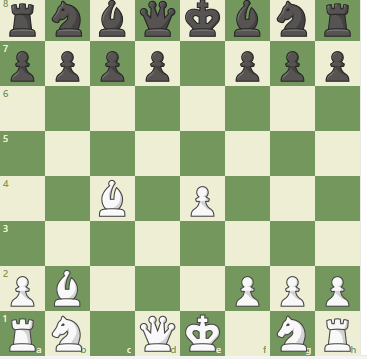
So enough with the background, lets talk the Danish Gambit! I love how it starts, white has both bishops out and it looks like black is just about done setting up his pieces:
Danish Gambit Accepted
Sure, white is down two pawns, but I've never had a Danish go to an end game where it matters. White either breaks through or is busted way before that. So from the position above, the full Danish Gambit accepted, what happens next?
Black has lots of choices.
First, the classical defense 5...Nf6. There are two responses for white. I normally play Nc3. I love the attack that comes out of this position. There's so many places for black to make a mistake. (example 1)
example 1
However e5 is an option too. This quickly spreads into several variations but here's one sample (example 2)
Next up is the Kolisch Defense 5...Bb4+. I've definitely seen this one played over the board. The check here seems irresistible to black as a way to try to catch up in development. The example below ends with mate in 5. (example 3)
example 3
Next up is something Lutes covers that I haven't had come up in a game, the Krause defense. (example 4)
example 4
Although I haven't seen the Krause defense in play it makes sense generally. The next possible response just looks bizarre. I'd be very surprised to see it. However, if it does come up hopefully I'm ready for it. It's the Nordic defense, 5...Nh6. In case your curious, the reason is to help avoid so many of the f7 shenanigans that come up in the Danish. (example 5)
example 5
Back to moves that get played a lot, here's the Steinitz Defense. 5...Nc6. (example 6)
example 6
So now we get to what's considered blacks best and most accurate response to the Danish Gambit, the Schlechter Defense 5...d5. This gives one of the pawns back to free up blacks position. (example 7)
This next one I hadn't seen until recently when a computer played it against me! The Tschigorin Defense 5...Qe7. (example 8)
example 8
Next up is a more modern defense. All the defenses above having come about around 1900 or earlier. It was claimed to be a refutation of the Danish but has seen little play, it's the Horowitz Defense 5...c6. (example 9)
example 9
There are also other irregular defenses and dozens of lines attached to the different defenses listed above. However, this is hopefully enough to give you a feel, and remind me, where the pieces often end up in a Danish Gambit. Again, if you're curious to know more, look for a copy of that book by Lutes, Danish Gambit Second Edition.