
Oh, sorry 
#20711 hrs ago
1. f3-f5 d8-d6
2. d3-d5 g8-g6
3. f5xg6 Bh9xd5
4. e3-e45

Oh, sorry
1. f3-f5 d8-d6
2. d3-d5 g8-g6
3. f5xg6 Bh9xd5
4. e3-e45

LXIVC -IvanKosintsev
3. f5:g6 Bh9:d5
4. e3-e4 Bd5-g8

1. f3-f5 d8-d6
2. d3-d5 g8-g6
3. f5xg6 Bh9xd5
4. e3-e45 Bd5-g8
5. Ng2-h4
LXIVC -IvanKosintsev
4. e3-e4 Bd5-g8
5. Ng2-h4 e8-e6

1. f3-f5 d8-d6
2. d3-d5 g8-g6
3. f5xg6 Bh9xd5
4. e3-e45 Bd5-g8
5. Ng2-h4 e8-e6
6. Nd2-c4
LXIVC -IvanKosintsev
5. Ng2-h4 e8-e6
6. Nd2-c4 c8-c7
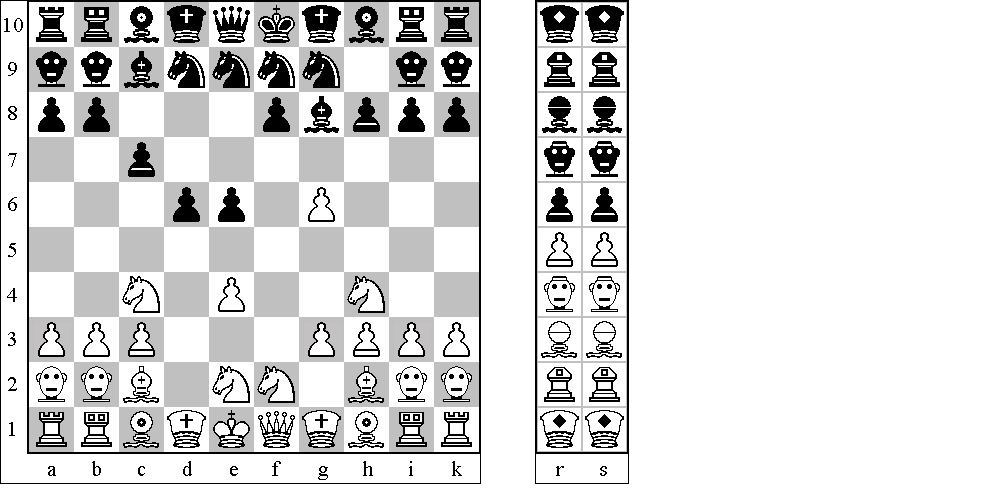
1. f3-f5 d8-d6
2. d3-d5 g8-g6
3. f5xg6 Bh9xd5
4. e3-e45 Bd5-g8
5. Ng2-h4 e8-e6
6. Nd2-c4 c8-c7
7. g3-g5
LXIVC -IvanKosintsev
6. Nd2-c4 c8-c7
7. g3-g5 e6-e5

1. f3-f5 d8-d6
2. d3-d5 g8-g6
3. f5xg6 Bh9xd5
4. e3-e45 Bd5-g8
5. Ng2-h4 e8-e6
6. Nd2-c4 c8-c7
7. g3-g5 e6-e5
8. Nc4xd6

I'm apologist of Free Chess. Every player has right on his own taste and on his own philosophy of chess. So players can choose and change on agreement the rules before the tournament and (why not) before the party.
That's something similar to Jazz.
Welll, that maybe true. But, when you let out an official game, whether it's Chess or one of its variants, everyone needs to consent to one set of agreed rules; otherwise, we would all be thrown into confusion.
Besides, your original rules of no-castling makes better sense than my proposition, anyways: The King can move two squares until check; since he's already moving 2 squares, what is the substantial benefit of castling? Two squares are achieved in both maneuvers, right?
I'm an amateur (besides a bad sportsman) and haven't nothing common with the official chess. I can say more. I'm a social (and chess) dissident and all officials have an aversion for me. The theory and the real life are two great differences. If chess people like chess variants (jazz) then we play chess variants (jazz), if chess people like the castling then we play chess with castling. But at heart and tête-à-tête my own variant is of course better.
I wouldn't at all mind playing without castling.
LXIVC -IvanKosintsev
7. g3-g5 e6-e5
8. Nc4:d6 Sc7:d6

Invisible chess!! =D
More seriously, Ivan, what happened to LXIVC's Knight on C4? lol
The knight Templar was killed by spy of Prince John (the uncle of Napoleon)!
My bad.
For some reason or other, I seemed to have skipped over the fact that he captured your pawn, in which his Knight was recaptured.
1. f3-f5 d8-d6
2. d3-d5 g8-g6
3. f5xg6 Bh9xd5
4. e3-e45 Bd5-g8
5. Ng2-h4 e8-e6
6. Nd2-c4 c8-c7
7. g3-g5 e6-e5
8. Nc4xd6 Sc7xd6
9. Ad1xd6
LXIVC -IvanKosintsev
8. Nc4:d6 Sc7:d6
9. Ad1:d6 Ga9-c7


It's not correct. Let's be accurate!