I just had a game incorrectly end in a draw

Sort:
Avatar of J3ll3

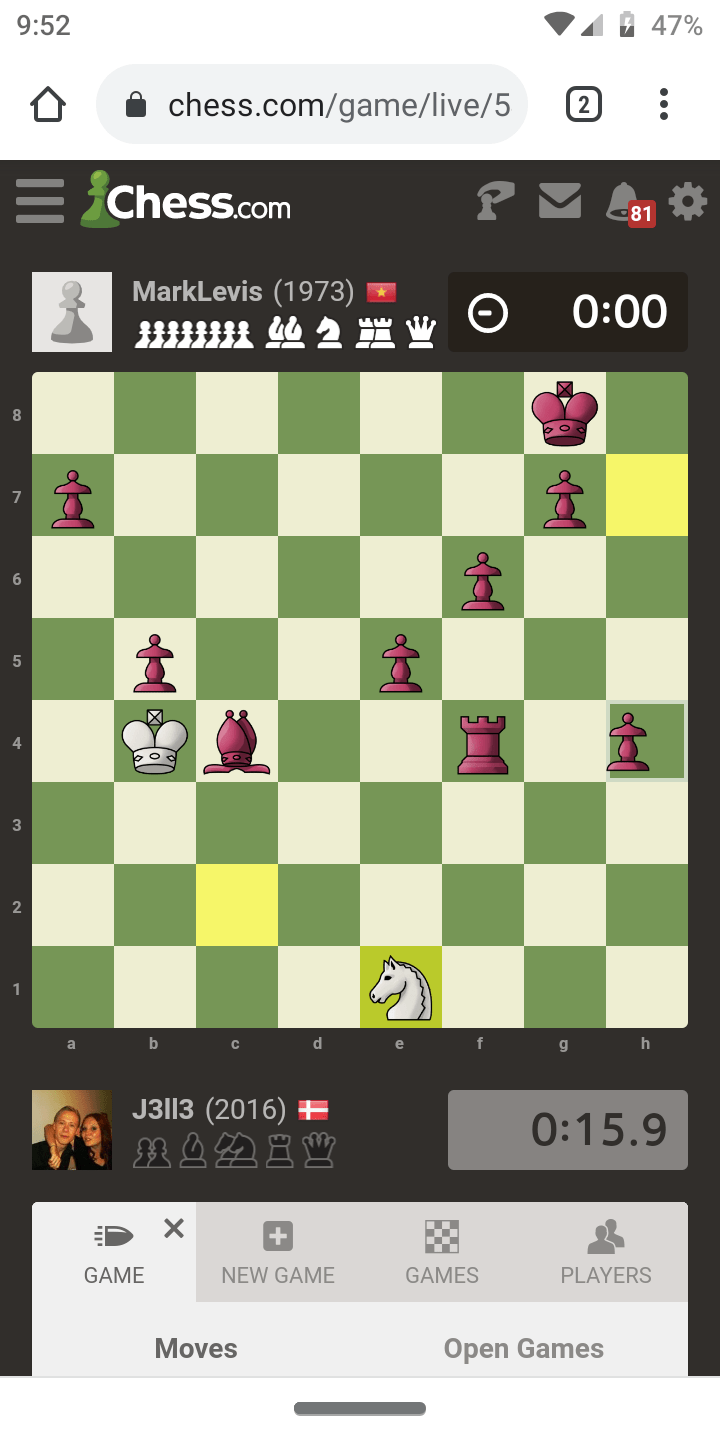
In my latest bullet game (https://www.chess.com/game/live/5479472465) my opponent ran out of time. However, the game was considered a "draw due to insufficient material" which is clearly wrong. As explained by the rules on Chess.com (https://www.chess.com/terms/draw-chess#dead-position) the position should not end in a draw since my opponent - with absolutely horrific play - could theoretically still lose the match. All he needs to do is place his king in a corner with a pawn blocking his path and then let my knight checkmate him. This situation is equivalent to the 2019 World Blitz championship which is highlighted as an example in the link I provided.

Avatar of notmtwain
J3ll3 wrote:

In my latest bullet game (https://www.chess.com/game/live/5479472465) my opponent ran out of time. However, the game was considered a "draw due to insufficient material" which is clearly wrong. As explained by the rules on Chess.com (https://www.chess.com/terms/draw-chess#dead-position) the position should not end in a draw since my opponent - with absolutely horrific play - could theoretically still lose the match. All he needs to do is place his king in a conor with a pawn blocking his path and then let my knight checkmate him. This situation is equivalent to the 2019 World Blitz championship which is highlighted as an example in the link I provided.

Well chess.com makes the rules here and under their rules, it's a draw.
Avatar of J3ll3

I am literally linking to Chess.com's own description of the rules. Clearly they should follow the rules that are both official chess rules and as stated by themselves.

Avatar of Martin_Stahl
J3ll3 wrote:

I am literally linking to Chess.com's own description of the rules. Clearly they should follow the rules that are both official chess rules and as stated by themselves.


Those are the official rules under FIDE, not here: https://support.chess.com/article/268-my-opponent-ran-out-of-time-why-was-it-a-draw


https://support.chess.com/article/128-what-does-insufficient-mating-material-mean


The site uses a modification of the US Chess rules and only looks at the material that the side with time has.

Avatar of J3ll3

That's absolutely bonkers. That means that you can potentially (but completely plausibly) have a game where your opponent would lose the game if he made a (forced) move but gets a draw if he simply lets the time run out instead - in other words the optimal play would be to "lose" on time because you are awarded a draw for doing so.

Avatar of notmtwain
J3ll3 wrote:

That's absolutely bonkers. That means that you can potentially (but completely plausibly) have a game where your opponent would lose the game if he made a (forced) move but gets a draw if he simply lets the time run out instead - in other words the optimal play would be to "lose" on time because you are awarded a draw for doing so.

It's just as absolutely bonkers for you to claim that your knight has winning chances.

Calling it a draw is a practical solution to the problem. 

Avatar of LeeEuler

I disagree. I like the ruling from Chess.com

Avatar of Lagomorph
J3ll3 wrote:

That's absolutely bonkers.

You got a draw while down 6 pawns and a rook ....and you are moaning ?

The rules on this site are clear. If you dont like them you have a choice.

Avatar of UWillResignYesUWill
Lagomorph wrote:
J3ll3 wrote:

That's absolutely bonkers.

You got a draw while down 6 pawns and a rook ....and you are moaning ?

The rules on this site are clear. If you dont like them you have a choice.

It's a bullet game and he flagged his opponent by 15 seconds. OP deserves the win

Avatar of Lagomorph
UWillResignYesUWill wrote:
Lagomorph wrote:
J3ll3 wrote:

That's absolutely bonkers.

You got a draw while down 6 pawns and a rook ....and you are moaning ?

The rules on this site are clear. If you dont like them you have a choice.

It's a bullet game and he flagged his opponent by 15 seconds. OP deserves the win

Would he get a win under USCF rules ?   No

So he does not get one here.

Avatar of UWillResignYesUWill

well, USCF pertains only to American chess tournaments as it's only a national federation. Chess.com is international. So, chess.com should go by the international chess federation(FIDE)'s rules to ensure international equity. Why does it go by USCF rules?? Always confused me

Avatar of notmtwain
UWillResignYesUWill wrote:

well, USCF pertains only to American chess tournaments as it's only a national federation. Chess.com is international. So, chess.com should go by the international chess federation(FIDE)'s rules to ensure international equity. Why does it go by USCF rules?? Always confused me

It's not internationally based. It is based in the US.

Chess.com gets no support from FIDE or from the USCF that I'm aware of.

Should that ever change, for example, if most international tournaments were to be hosted on chess.com-- things might change.


Avatar of Martin_Stahl
UWillResignYesUWill wrote:

well, USCF pertains only to American chess tournaments as it's only a national federation. Chess.com is international. So, chess.com should go by the international chess federation(FIDE)'s rules to ensure international equity. Why does it go by USCF rules?? Always confused me


There was a really long discussion a few years ago about implementing an algorithm that would adhere more closely to FIDE rules in this situation. At the time, it was mentioned that the current implementation adheres closely to US Chess rules on insufficient material, makes more logical sense, and is much easier to program the checks.


The FIDE rule is designed to remove arbiter judgement calls and is inherently easy to show that mate is possible to a human. You just set up the mate on the board since you don't actually have to worry that much about the moves to get there. That is not easy to do programmatically. The best that can be done, is to check for material combinations, similar to what is currently done but there are a lot more edge cases and checks to make where you still might get it wrong from a FIDE point of view.


So in short, the site took an expedient method and one that is more logical than what FIDE has, where you assume the player with the material advantage might play the worse possible moves to get mated.

Avatar of J3ll3
Martin_Stahl skrev:
UWillResignYesUWill wrote:

well, USCF pertains only to American chess tournaments as it's only a national federation. Chess.com is international. So, chess.com should go by the international chess federation(FIDE)'s rules to ensure international equity. Why does it go by USCF rules?? Always confused me


There was a really long discussion a few years ago about implementing an algorithm that would adhere more closely to FIDE rules in this situation. At the time, it was mentioned that the current implementation adheres closely to US Chess rules on insufficient material, makes more logical sense, and is much easier to program the checks.


The FIDE rule is designed to remove arbiter judgement calls and is inherently easy to show that mate is possible to a human. You just set up the mate on the board since you don't actually have to worry that much about the moves to get there. That is not easy to do programmatically. The best that can be done, is to check for material combinations, similar to what is currently done but there are a lot more edge cases and checks to make where you still might get it wrong from a FIDE point of view.


So in short, the site took an expedient method and one that is more logical than what FIDE has, where you assume the player with the material advantage might play the worse possible moves to get mated.

I completely fail to see how the USCF rules are "more logical". Here's how I see the logic: If my opponent has run out of time, that means he is no longer allowed to make any moves. Thus I get to decide all the remaining moves of the match - like a kid playing a game with himself. To put it slightly more elegantly: If a player does not complete the prescribed number of moves in the allotted time, his opponent gets the best result he can achieve by any series of legal moves.

Why on earth should my opponent be allowed the luxury of the assumption that he would make the best mate-avoiding moves possible with no time to make them? And that's without even considering edge cases where you could have a forced mate in one move, but your opponent can achieve a draw by letting his time run out.

Avatar of UWillResignYesUWill
J3ll3 wrote:
Martin_Stahl skrev:
UWillResignYesUWill wrote:

well, USCF pertains only to American chess tournaments as it's only a national federation. Chess.com is international. So, chess.com should go by the international chess federation(FIDE)'s rules to ensure international equity. Why does it go by USCF rules?? Always confused me


There was a really long discussion a few years ago about implementing an algorithm that would adhere more closely to FIDE rules in this situation. At the time, it was mentioned that the current implementation adheres closely to US Chess rules on insufficient material, makes more logical sense, and is much easier to program the checks.


The FIDE rule is designed to remove arbiter judgement calls and is inherently easy to show that mate is possible to a human. You just set up the mate on the board since you don't actually have to worry that much about the moves to get there. That is not easy to do programmatically. The best that can be done, is to check for material combinations, similar to what is currently done but there are a lot more edge cases and checks to make where you still might get it wrong from a FIDE point of view.


So in short, the site took an expedient method and one that is more logical than what FIDE has, where you assume the player with the material advantage might play the worse possible moves to get mated.

I completely fail to see how the USCF rules are "more logical". Here's how I see the logic: If my opponent has run out of time, that means he is no longer allowed to make any moves. Thus I get to decide all the remaining moves of the match - like a kid playing a game with himself. To put it slightly more elegantly: If a player does not complete the prescribed number of moves in the allotted time, his opponent gets the best result he can achieve by any series of legal moves.

Why on earth should my opponent be allowed the luxury of the assumption that he would make the best mate-avoiding moves possible with no time to make them? And that's without even considering edge cases where you could have a forced mate in one move, but your opponent can achieve a draw by letting his time run out.

This. 

Avatar of ChessLosrz

@notmtwain @J3II3 you fail to see that the king is not in check, although he is trapped.

Avatar of ChessLosrz

you ALSO lose if time runs out, in case you didnt know

Avatar of Lagomorph
ChessLosrz wrote:

@notmtwain @J3II3 you fail to see that the king is not in check, although he is trapped.

Wrong

Avatar of Lagomorph
ChessLosrz wrote:

you ALSO lose if time runs out, in case you didnt know

Wrong again


you want to have a go at making it three out of three ?

Avatar of Martin_Stahl
J3ll3 wrote:

I completely fail to see how the USCF rules are "more logical". Here's how I see the logic: If my opponent has run out of time, that means he is no longer allowed to make any moves. Thus I get to decide all the remaining moves of the match - like a kid playing a game with himself. To put it slightly more elegantly: If a player does not complete the prescribed number of moves in the allotted time, his opponent gets the best result he can achieve by any series of legal moves.

Why on earth should my opponent be allowed the luxury of the assumption that he would make the best mate-avoiding moves possible with no time to make them? And that's without even considering edge cases where you could have a forced mate in one move, but your opponent can achieve a draw by letting his time run out.


If you honestly don't think that it makes more sense that a king and knight doesn't deserve a win in such a position, then I guess we'll just have to disagree on the logic. 


The FIDE implementation, as mentioned, takes all judgement out of the situation, so does not require arbiters to make a call; just have to show mate is possible, no matter how implausible.


However, it's all academic unless you can get the site to change its implementation. Based on the previous discussions I've read, I don't see it happening. But I've been wrong before.
