
King Playing with Queen


Imagery of Chess
Dorothea Tanning died in her sleep on the last day on January in 2012. In less than seven months she would have been 102. At age 94, she published a novel, "Chasm: A Weekend." That same year she published a collection of her poetry, "A Table of Content." At age 90 she published her second memoir, "Between Lives" to supplement her previous one, "Birthday," published when she was 76.
That was Dorothea Tanning, re-invented for the third time.
 Max Ernst and Dorothea Tanning, 1946
 Tanning and Ernst in Lee Miller's 1947 photograph.
The second re-invention fully occurred when she met artist Max Ernst. Before then Dorothea was a small-town girl with great vision- though living in NYC, supporting herself as a fashion illustrator for Macy's department store - but with little direction and just beginning to embrace surrealism in her fledgling art endeavors. Ernst had fled Nazi-occupied Europe for the US and was married to Peggy Guggenheim, his third wife, when he met Tanning in 1942. Ernst persuaded the art impresario, Guggenheim, to include Tanning's work in a show to be entitled, "31 Women." Later Guggenheim said she wished she had kept it at 30. One of her two entries was entitled "Birthday," a title coined by Ernst when he first saw the piece.
 Birthday (self-portrait at age 30) Dorothea Tanning, 1940
Eventually Ernst and Tanning married and moved to Sedona, Arizona where Tanning's art blossomed. Despite her immense talent, Tanning always lived in Max Ernst's shadow (in much the same way that Jean Arp overshadowed his equally talented and possibly more versatile wife, Sophie Tauber-Arp). Years later she would write:
Many years ago today
I took a husband tenderly.
This simple human gentle act
Seen as a hard decisive fact
By all who dote on category.
Did stain my work indelibly?
I don’t know why that is
For it has not stained his.
In 1956, however, the US government terminated Ernst's citizenship and they moved to France (between 1949 and 1956 they had spend a lot of time in France anyway).
When Ernst first met Tanning, they played a game of chess. Thereafter, chess formed an intimate part of their relationship and even their art.
 Ernst and Tanning in Sedona, Arizona, 1948.
The most evident display of chess in their art was displayed in Julien Levy's Imagery of Chess show in 1944.


the squares importance through different shades of gray ↓

 Here is Ernst's set displayed on a table created by sculptor/architect Isamu Noguchi
Besides the King Playing with Queen sculpture (above top), Ernst's other contribution to the Imagery of Chess show was his famous chess piece design:


But there's far more to this design than is readily observable. The design itself has a long history culminating in what Ernst considered one of his masterpieces.
The origin of the design was about 1929 when Ernst conceived each figure individually with this bronze example called "Roi, reine et fou" :


The 1944 boxwood set was the next evolution, followed by this 1952 example called,
Madman, Queen and Horse:


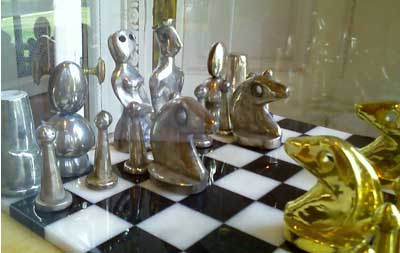
In 1966 Ernst made the following "Roi, reine et fou" set with gold and silver pieces:
 Gold
Gold
 Silver
The final form of Ernst's chess vision is this gigantic glass set:
This set can be seen in detail in a video: HERE
an Ernst set displayed at the Nassau County Museum of Art in Rosyln Harbor, NY
(photo compliments of my cohort, Deb):

When Max Ernst died in 1976, 35 years ago, Dorothea lost her soul-mate of nearly 35 years. Moving back to the United States, her final reinvention as a writer and poet was nearly as revolutionary and encompassing as her reinvention as a surrealist.

 Capricorn
