Upgrade to Chess.com Premium!

Computers have Solved Checkers: Is Chess Next?

  • erik
  • on 7/22/07 9:26 AM.

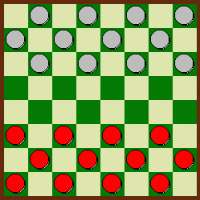
After roughly 1,000 years of total computing time (~50 computers working for last 20 years), the game of checkers is no longer a game: it is simply a puzzle. Professor Jonathan Schaeffer has proven that with perfect play from both sides, checkers is a draw. What this means is that if you can store all 50 billion billion (yes, double billion as in 5x10²⁰) possible positions in your head, then you will never lose a game of checkers again!

What does that mean for chess players like us? Will computers solve chess? YES. Will it be soon? Probably not. There are more possible chess moves than there are atoms in the universe (read more here).

My question is, will this make me less interested in chess? Will it suddenly change the way everyone plays? I'm going to say NO. If Bill Wall can still beat me when opening with 1. h4, then I have a long way to go before I lose interest in chess... how about you?

(To play against the perfect checkers computer, click here!

11795 reads 31 comments
4 votes

Comments


  • 17 months ago

    Jeff_Russ

    F@@k this forum-It's either incompetent or it's CS.  Sayonara,-I'll find another less 'sensitive' venue. J

  • 17 months ago

    Jeff_Russ

    My rather innocuous comment was not posted.  Basically it asserted that chess is a finite game, and the number of germane games was solvable-What is so scary about that?

    J

  • 17 months ago

    Jeff_Russ

    It's not the total number of chess games possible-It's the number of non-trivial chess games possible.  For instance Hn as an opening move against a 3300 rated computer program would not get you far-Probably all of the major chess openings have been discovered.  Or for instance a mate in 'n' which is drug out intentionally-certainly increases the number of total chess games-but all of them trivial.  So the question I pose is:  How many non-trivial chess games are there?  This would be optimal play by two super-grandmasters, each playing to win in as few moves as possible or if that is not possible to draw.

  • 23 months ago

    sysop2001

    It's easy to solve. Only it will take about 20 years to process all the possible positions. Using the same techniques as DNA mapping. Simply by using a basic random generator to select each move from it's parameter and eliminate duplicate positions. I could do it in Java if I really wanted to. But who cares? lol
  • 2 years ago

    pmneel

    Applying Moores Law to the number of board positions in Checkers and moving it forward until we see a number of board positions close to the number in Chess then we get a solution to the game in the fall of 2012!

    Number of Checkers board positions = 5E + 20

    Number of Chess board solution = 1E +120

    Moores Law yearly exponent = 1.4----- ish ( 2 for two years )

    Even if the estimate for Chess board solutions is off by double it would only be fall of 2014 before a solution was reached.

    PS This is only for fun. I know there is a little more to the story here

  • 3 years ago

    lebronjames6

    160000^100 is the widely accepted # of chess positions plus or - an error margin of 140000^97 which is still remarkebly impossible to calculate

  • 3 years ago

    aperisic

    Chess has its own set of rules, and as such it is a system. I did not see developed a system that would treat each figure as a separate element of the system with its own way of thinking. In essence we need 32 nodes (processors) for figures 64 nodes for a chessboard. Then we need at most 32x32x64 connections, which is not too much ~65000, and we can make a connection very fast even 1Tb/s. With this specialized hardware, chess processor, which would not be cheap to make, we can teach each node its basic rules and basic tactics as well as role, and feed the system with many known positions so it can learn the tactics, I guess 16Tb memory would be more than sufficient for that. Now we let this system play against other computers for a year or two fixing some tactical issues.

    The difference between this system and the system we have today is that no man would know how this system plays - you would not be able to describe it. This system which I would call The Chess Brain, in time, could be so advanced that it may encompass not all positions but virtually the entire dynamic of chess.

    The only problem is that we should combine the development of software for a Spitfire dynamic and something that is really not a chaotic system, and we do not have a software methodology for that yet, but it does not mean it is impossible. We need something like combination of NASCAR and Intel/Amd. Why NASCAR? Because they like to bring cars at the edge of technology. In essence we should develop a program for chess as if it is a spacecraft assuming that we do not want to play it move by move, but fly with it at immense speed.

    Sure, development of this system would strip much of the beauty out of the chess in some segments, because today only those who play chess and play it well are making chess programs. This system I suggest is like creating a huge matrix of the system that would give a very good parameters for playing every next move. Does this matrix exist? Of course it does, it might be infinite, but it does exist. However, even if you would create one or make a good approximation of it, it would not be a sacred chess any longer as it is today for many.

    Why should we create this system that is going to learn to play chess on its own? Because we assume we can play chess, and that might be true, but we do not know how well we play, and how well it can be played. We do not know yet what exactly is behind chess. We believe, play it and make a program for it taking that it is a dynamical system that develops in time which is only ONE side of the chess.

    To make a joke, this system that will learn to play chess might start developing into something more than chess :)

  • 5 years ago

    mortal

    No,it's not a draw.
  • 6 years ago

    Hugh_T_Patterson

    The ebb and flow of ocean waves breaking upon a rocky beach is a beautiful sight indeed. We marvel at the repetitive motion of the overlying scene. Yet we marvel at the slight difference between each wave. We can use mathematics to describe the subtle nuances in each wave and the overall uniformity of the larger wave patterns. In short we can use a set of predefined equations to map out a mathematical landscape that describes the vision before us. Computers aid in the calculations, compressing what used to take ten years to mathematically map out and condensing it into a matter of momentary effort. While wave motion and and the subtle chaos that underlies each wave's difference are essentially solved from the mathematician's view point, does it take away from the beauty or art? No

    Almost anything can be broken down in terms of mathematics and solved like a complex puzzle. The geometry and draftsmanship of 18th century painters can be broken down in mathematical terms. This means a computer armed with a device allowing it to paint (think a very delicate roboctic arm) could reproduce every single brush stroke. A song could be recorded using computer generated sounds that duplicate every note and nuance of a song written and recorded fifty years prior. However, no computer will ever be able to reproduce the human emotion that went into painting that masterpiece or the feel of a guitarist's hand on the fret board of a guitar, bending the string a hair past the fret's edge to get that over the top sound.

    You may be able to solve chess like a single complex puzzle, but the computer will never experience the thrill of that first win or the satisfaction of sitting with an old friend and playing on a cold rainy night. There are many mysteries that have been solved but their beauty remains intact. Chess is one of those things. That we will one day solve chess as if it was a great puzzle just means we can do so. To those who play the game for it's art, nothing will change. The human brain can only retain so much information. Human emotion can cloud sound judgement.Simply being human will always make the game fascinating to play. Why? Because we are not computers, we are human beings will human flaws!

  • 6 years ago

    Creg

    <chopra> Excellent point and I wholeheartedly agree, but the question for this forum is whether or not chess will be solved by computers. I've given my response to that earlier in this thread. However, I agree with you that it is a game that humans play, and humans err. Not only this but it takes 10 years or more to master, well does anyone truly master it...Smile, on average, or more precisely about 10,000 hours. This unto itself may only bring you to 2400, and when you reach this level, a whole new generation will have begun to discover the beauty of this game.
  • 6 years ago

    chopra

    I think the point is "chess is a human game", is for humans to enjoy it and develop their minds potential. I ask a question: why a great master sometimes wins a game and sometimes losses a game playng with the same opponent? because it is a "human game", made for humans to be enjoyed for humans. You never will reach the maximun level of expertice possible, you will reach the maximun level for you and that is what makes this game something marvelous. As it'll be possible, I will never stop playing chess!
  • 6 years ago

    Creg

    This will give you an idea of how difficult, and how long it will be before chess is solved.  The following statement is from Dr. Jonathan Schaeffer who, with the help of computing power, solved checkers.

    .... 

    10 to 20th power for checkers and 10 to 40th for chess. To get some idea of this, if a computer could solve checkers completely in one nanosecond (a single cycle of a 1 GHz computer), it would take this computer 3000 years to solve chess.

    ....

    Please note that it took the good Dr. 20 years to solve checkers with 50 computers! 

  • 6 years ago

    Trickster

    I don't care if its solved by computers or not! Anway we could not memorize all those moves that computers do!
  • 6 years ago

    rowrulz

    Daemon_Panda you are a funny guy!

    I think there will come a time in the not too distant future where chess variants (for instance swapping the positions of the knights and bishops in the starting position) will become a valid alternative in the professional arena.

    This is down to opening theory which for me saps a lot of the fun out of the game! I play a few international tournament but never really have time to work much on my openings - so I often end up with worse positions from the opening and have to struggle. 

  • 6 years ago

    MolotovRuss

    Chess is indeed next to be "solved", but what a terrible shame! To know there's some form of formula that allows you to never lose, even though it's not humanly possible, is a terrible thought!
  • 6 years ago

    Phobetor

    chessiq made a good point. Most of us aren't playing chess because it's unsolved, but because it's fun, challenging, etc.. Even though certain position have already been solved (Endgame Tablebases), still even the best of the best Grandmasters are often unable to find the best moves (check for example Carlsen - Aronian, Candidates Matches 2007). Now those positions have already been solved by computers without too much problems. Solving chess itself is incredibly much harder for computers. So how hard will it be for humans to memorize all variations, even if chess is solved?


    The consequences of solving chess are just that (1) it's no use anymore to let computer play eachother, (2) players will be able to better analyze their games and know 100% sure that they either made a good or a bad move, and (3) that theory will be updated and will show which openings are theoretically the best openings. But it won't mean that the best grandmasters will always draw their games (if chess is a draw). It's just impossible for humans to memorize billions of moves and positions. 


    But I don't think chess will be solved soon anyway. As some already pointed out earlier, chess is way more complex than 8x8 checkers, and the exponential growth of speed of computers and processors will eventually come to an end. 

  • 6 years ago

    Sprite

    "Now, while we see computers growing in performance, there is no possibility to calculate (at least not with a modern computer) something larger than the number of atoms in the universe, because calculations rely on electrons."

     I wasn't aware of this before, and now I'm a little more relaxed.  The beauty of chess for me is the unknown, and how there are many, many, many possibilities from each position....  That does make sense though, and I hope that its the case.  Chess is such a beautiful game, and I would hate to see potential players become uninterested as chess is already "solved" like checkers.

  • 6 years ago

    Daemon_Panda

    It seems cliffhanger is partially wrong, I already have a proper formula for 64 moves.

    Some new math terms are needed so... I will explain everything in a different blog that I will make another time

    here is the formula:

    128 to the power of ser.127, to the power of ser.126, to the power of ser.125… ( keep counting down all the way to ser.2) to the power of 20 (the number of moves that can be made in the opening). I'm surprised I figured it out myself.

     Ser. = number of possibilities before each move.

    127, 126, 125... = series number


    Why 128? So you have a move for white and a move for black


    MATH GENIUSES NEEDED PLEASE HELP!!!


    Please do not copy this, I'm hoping to publish this if I get more numbers : )

  • 6 years ago

    Daemon_Panda

    I have made a break through@!!! I gtg but Ill post the numbers later
  • 6 years ago

    Daemon_Panda

    It will be a long, long time.

    To know this, you have to think numbers. I'll write a formulae.

    Lets start with the openning. I'll just label all possible moves as 'n' (too tired to find  the number :))Then we find all possible midgame moves labled 'N'. Instead of using infinity for number of moves I'll use Erik's game vs Chessiq, which has 64 moves.


    To  really write out the formulae, I need exact numbers as well as help identifying the complications (such as pawns having two or one move, rooks can't move at first, ect.)  HELP IS WELCOME!!!!

    So far the formulae is (n to the N power) to the 64th power) to the 64th power

    trust me it makes some sense... it will be refined tomorrow (the N power part may be cut out)

    The idea is to find what number is what in the formulae, as well as to figure out what numbers go where. such as my password has 42 letters with 26 possible letters for each slot. so my password is one of (42 to the power of 26) possibilities 

Back to Top

Post your reply: