
e5 seems strange to me, even after Bxh7.
h6 mistake?
Sort:


Stavros_34 wrote:
Probably you mean h3 for white
Those where the main reasons he lost. The move h3 it happened to be a potential weakness.
I know black won and white had some more obvious blunders. I am specifically asking about h6 to avoid Bxh7 (in this case, also check) as seen in the game diagram.
I am also asking if h6 is associated with the Scotch opening.

This is the reason I have always told tiger prowl to add the coordinates to his game diagram's. To avoid making himself look foolish for no reason at all.
I don't know what you guys are smoking, if Nxh7, then Qxd8.
I don't need coordinates.
"You don't need coordinates but we are not in your mind."
That is why I posted the game and gave the ONLY variation which spells out what I was asking about. I don't know how much clearer I could be. However, thank you for your comments.
Since you say h6 is not necessary, how would you have handled Bxh7+?
You lost me. How does N go to e5 in this position?
Q went to h4 at move 13. Are we looking at the same board?

tigerprowl9 wrote:
"You don't need coordinates but we are not in your mind."
That is why I posted the game and gave the ONLY variation which spells out what I was asking about. I don't know how much clearer I could be. However, thank you for your comments.
Since you say h6 is not necessary, how would you have handled Bxh7+?
Kf8?
After 15 Bxh7, black should be much better, so I would not care to much about playing h6.
Interestedly enough, 12...Nf6 is one of those weak moves made in response to a nonexistent threat that Silman is always going on and on about. If Black played Nd7 to relocate the knight to the e5 square, he should have relocated the knight. After 12...Ne5 13. Nf3 can be met with 14...g6, after which 15. Qh6 Nxf3+ 16. gxf3 Re5 intending Rh5 is completely lost. 12. Kh1 is slow and the "threat" of f4 not potent. 12. Nb3 is a change of plans, but 13...Bb6 14. Bg5 f6 15. Bf4 Be6 is ugly, but fine for Black.
Stavros_34 wrote:
Who said about move 13? I wrote 12...Ne5.
If you won't address 13, why talk about 12? Where is your logic? Can you not look at the original post and see the question was about black after 12. Qh5?
Stay on topic please.
"After 12...Ne5 13. Nf3 can be met with 14...g6"
Good, someone is listening. Why is g6 better than h6?
Playing d6 makes no sense. You should pish the d5 pawn as quickly as possible.
After 12...Ne5 13. Nf3 g6 is better for a very concrete reason; White is forced to move the queen and his kingside pawn structure falls apart. White then either has to exchange queens for a worse endgame, or leave the queens on and face a strong kingside attack. Either way, White drops the h pawn.
You are missing the point, with reasonable play White never has a kingside attack which would require Black to play h6.
LOL I agree with Stavros_34. Don't beat yourself up to much Stavros Tigerprowl doesn't understand becuase he doesn't know where the square e5 is. You should have gave him a diagram so he could see it becuase he doesn't understand text.
Frankly I don't see whats the big deal. White isn't threatening anything. What does he plan to do after he steals the h7 pawn? Run away into a passive defense with the white piece's.
Look at all of blacks piece's that are active
- 1 dark bishop hitting/pinning f2 pawn on the white kingside
- 1 light square bishop hitting the h3 pawn on whites kingside
- 1 rook on e5 center of the board controlling the file
- 1 knight on f6 hitting center squares
- black also has a center pawn that white doesn't have.
Inactive
- Queen isn't that active yet;however, can become active pretty soon. Present moment not active.
- Rook on A file is also inactive ;however, he doesn't need it yet.
Look at all of white piece's that are active
- Queen for white is active on h4
- Light square bishop is active on h7 hitting the black's kingside
Inactive
- White has a rook on the A file not doing anything
- 1 bishop on c1 that is blocked by a knight on d2
- 1 knight on d2 that is hitting center squares that black already controls not a very good spot for that knight.
- Rook on the F file in defense supporting the f2 pawn
I mean does it really surpise you that black won this game? Both sides have 6 pieces in total and black has 4 pieces active vs whites 2.
4 to 2 odd's. I mean do you think black cares about playing h6 or g6 in this position. Frankly black is probably hoping and praying white is stupid enough to take the h7 pawn so he can later play g6 and swing the A rook that isn't active to the h file.
you just have to ask yourself how on earth did white end up less active than black when white starts the game off first.
Stavros_34 wrote:
No Tigerprowl...you are out of topic.
Move 12 precede move 13. Your mind is stuck on move 13 because you can't understand that 12...Nf6 is a ghost!
Live with your ghost! Tracking off....
I don't know what you mean by ghost, but the original post has, "Is h6 for black the main mistake in this game?"
In this game. This means the game I posted. If you are suggesting a variation then say so, but please after commenting on moves pertaining to the game played.
I intended to post a game played for analysis, not a variation of the game played. I understand you may be saying Ne5 is better, and for argument sake I will agree with you.
However, I want to know if N goes to f6 instead of e5, should black play h6?
That was the topic I started this thread around.
"What does he plan to do after he steals the h7 pawn? Run away into a passive defense with the white piece's."
Ok, so you don't mind giving up Hannibal the h pawn?
tigerprowl9 wrote:
"What does he plan to do after he steals the h7 pawn? Run away into a passive defense with the white piece's."
Ok, so you don't mind giving up Hannibal the h pawn?
Black didn't give it up. It was a trade not a gambit. White gave up (center Epawn) for a (side H pawn).
Pawn's are equal in this position materially. Center pawns are usually worth more than side one's.
White has no attack here he can't checkmate with 2 piece's. When black has over 4 pieces that are capable of defending pretty fast. Taking the H pawn only helps black becuase now black has another open file to put a rook. White has no way of controlling the H file with a rook becuase his rooks are not active and the white queen is to valueable to go against a rook. After the white bishop retreats. Black will more than likely play Rh5 hitting the white queen chasing it away as well. Than black can play g6 and swing the rook on A file to H file. Double rookings on the H file. White is in no position to attack. Black has to many active resources against white. White can pray for getting a draw maybe.
"im still having problems understanding how you can ask about whether h6 was a mistake when it was never played."
Really? You can't fathom this idea? 
Wow, are we intentionally not trying to see blindspots? How about a picture? I will agree with Stockfish 6 or Komodo 8 before any of you. If you can't grasp this, then I am more unhuman than human I guess.
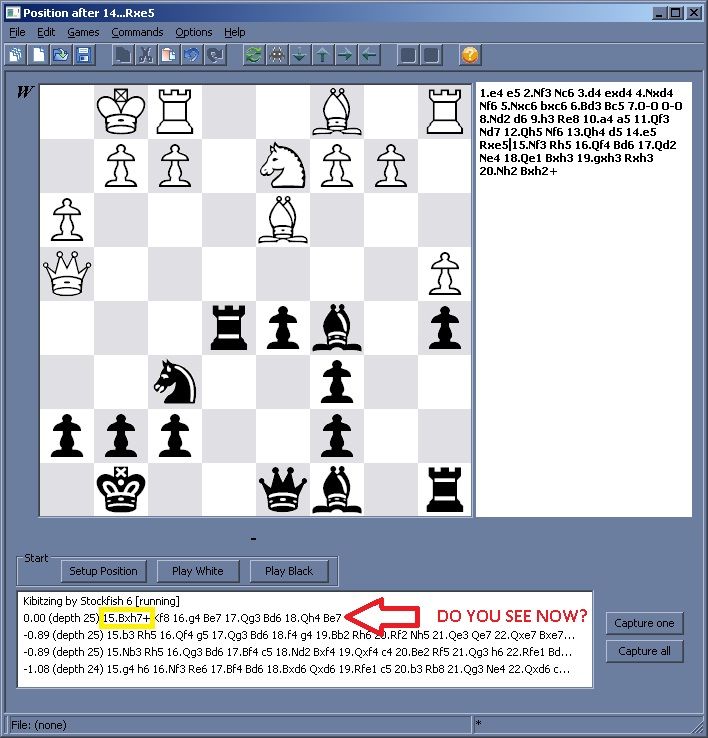
Bxh7+ looks like a better move, but I didn't play "h6" to prevent it. Therefore, I think it may have been a mistake. If I were to play this position again, should I have? That's all I am asking. Is this really that hard to understand?
tigerprowl9 wrote:
I believe you are wrong. You can't say h6 is a mistake if it was never played.
For example at move 15 white played Nf3 instead of Bxh7.
The move that is the mistake is 15.Nf3 for white becuase that was the move played and the better move is Bxh7.
As for black h6 is not a mistake becuase it was never played.
I will also add that I believe blacks inaccuracy or mistakes happened around the move 12 or 13.
So your mistakes were either 12...Nf6 instead of Ne5 like Stavro_34 has been saying this whole time.
or
Move 13...d5 instead of moves like Bd7 connectioning rooks/ Ba6 trading off whites strong LSB/ Rb8 putting rook on open file
Alot of possible moves that are not as bad as the move d5.
After you play the Move 13...d5. White played e5 which is a forcing move hitting your knight.
After move 14 black was forced to deal with the pressure against the knight on f6.I believe 14...Rxe5 was the best move by black at that point.
Which is why I agree with Fiveofswords. I personally do not see how you can call h6 a mistake. I will even go as far as to say I don't even see Where exactly you plan to play the move h6 at in this position?
Is h6 for black the main mistake in this game? Also, Is this often played with the Scotch opening?