
Anti-pirc
As far as I know, there isn't an article about any Anti-Pirc lines. So I'm glad to show this interesting one (it is called the delayed spike).... I used to play the Pirc a lot (as my name indicates), so I know this is a dangerous line! ...
As far as I know, there isn't an article about any Anti-Pirc lines. So I'm glad to show this interesting one (it is called the delayed spike).... I used to play the Pirc a lot (as my name indicates), so I know this is a dangerous line! ...

A few weeks ago, I played this game. Demonstrating the danger of underestimating an opening - and also your opponent. My rating, from quite a few years ago now, since I've stopped competing regularly, was quite a lot lower than my opponent's. Ho...

Try moving your pawns to squares that anticipate the opposing Knights second moves in opening play. For example: If playing Black, move c6 to counter N-f3 on the King side or f6 to counter N-b3 on the Queen side. This is an extension of the Car...

One of the dilemmas of modern chess is that opening theory has grown to huge proportions. The advent of computers and databases mean that there is plenty of information about a player's tendencies, strengths, weaknesses, etc. Throw in some strong ...

Here is a game from the 2009 Reykjavik Open, FM Thorfinnsson - FM Lucaroni with full commentary and annotations: I was very interested in first seeing this game. The Dutch defense has been a bit suspect at the highest levels of...

In this game, W Foldeak faced off against F Nagy in Budapest, 1942. Here, we see White's marvelous Knights dance around the board into Black's defences! After the 8th move, it took just 5 brilliant moves for White to force Black to resign. "Gallop...

In Chess, you start out with your prepared opening. Here is one thing to consider. When playing your opening, I reccommend that do not move a piece twice in the beginning unless you are forced to or their is a good thing in return. When white, m...

International Master Andrew Martin from England presents a regular series of articles to answer any questions that Chess.com readers have about the game of chess. If you want to ask Andrew a question, then send an email to askandrew@chess.com and...

chapter V now let's learn the theoratical draws eg: as you see after kxg1 Black has only a light squared Bishop and Whites king can just cruise on the dark sqares so it is known as a draw.now the next : no point in continuing cause ...
chapter IV hello again,kann here last time i taught you a basic checkmate this time it's a stallemate ex:when a lonely king has no legall move including he has no checks it's known as stallemate eg: just now you can see a pawn for black many wi...
ok now were ready for our second lesson: chapter II checkmates(#): ok now u have seen a basic checkmate (Q&K #) now lets learn the notations of chess eg:kf2,if you find it hard hard to learn you are definettely wrong.before we get to the l...

These days you can find a TV game show about anything. Well, almost about anything. There is no game show about chess. Call me a hopeless nerd, but I would love to see the face of the contestant who gets a question “ What chess player having a ...

This game is about one line of the Queen's Indian Defense. White is Garry Kasparov. He was born April 13, 1963 in Baku, Azerbaijan. He won the world championship in 1985 from Anatoly Karpov. He was FIDE champion until 1993 when he split with FIDE....
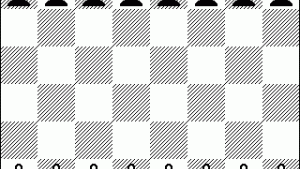
Part I:Discovery Discovery is a way to devastate you opponent's material using a check by moving aside a piece and placing that piece where you can threaten opposing pieces. one of those pieces would be already lost, since your opponent has to do...
Hello KANN here i'm here to teach you the basics of the game chess.with out further a due let me get to the basics. chapter I pieces: t...

A gambit, traditionally, is a pawn sacrifice in the early stages of the opening. There are many reasons that gambits are played: often to gain tempo, good/quick development, to weaken an opponent's position; but not many people realise the psychol...
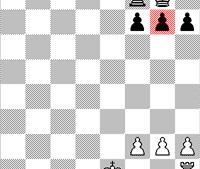
After king has castled,attacking the g2 pawn (usually with rook) to destroy enemy's defenses is a method that we are going to analyze with some examples. At the first diagram black is threatening Qa1 mate but white takes adv...

I would like to talk about positions when one side gives away a piece and in return gets a couple of pawns. It is a great advantage if those pawns are passed pawns, because their strength is twice regular pawns. It is not easy to take into acc...

You have probably noticed that we have changed our title names in the article. You must have read plenty of articles and maybe seen some videos where people and sometimes Anand himself try to explain the secret behind his first and last names. Wel...

When you are playing a chess game you should always try to control the center of the board because of two (2) things. 1) It makes it easier for you to move about your pieces and get them out where they can be useful. 2) Your enemy will find it...
Some combinations and tactics with queen and rook and how these pieces can give winning possibilities. For some other variants check "MOVE LIST" At the first example white threatens Qxc7+ and Qb7 mate.Also white's b...

In 1834, between the months of June and October, the Westminster Club of London celebrated a series of matches between the best chess players of England and France, or in fact, the best chess players of the world, since in those times Paris an...

Once again I will be addressing my favorite defense to 1. e4, the Sicilian Pelikan This opening is characterized by the move order 1. e4 c5 2. Nf3 Nc6 3. d4 cxd4 4. Nxd4 Nf6 5. Nc3 e5! ...

Below i have two interesting examples about how someone can penetrate king's defenses.Enjoy! Don't forget to check "MOVE LIST"


