It's the dream of every chess amateur—establishing your name in the chess firmament by winning an "Immortal Game." In this way, chess is a meritocracy; a beautiful game is a beautiful game, and you don't need to be a world chess champion to ...

It's not often that humans outperform chess computers these days, but it DOES happen. Check out the incredible 23.Qxe5!! from Gusev vs. Auerbach, 1946. This queen sac proves to be the only forced win available, but chess engines don't see it!
Th...

The two opponents in this game, Savielly Tartakower and Max Euwe, share some unique similarities in the chess world. At the time this game was played, both players were well established in the chess world. Tartakower was already one of the best pl...

It's the dream of every chess player playing the white pieces, crushing the Sicilian Defense with numerous sacrifices! The Soviet master, Ravinsky, does just that by sacrificing both rooks and a knight to fully expose the black king in the followi...

Baruch Harold Wood was a fixture of British chess for decades. In 1935, he founded the magazine, "Chess," and he edited the magazine for more than 50 years, up until 1988. Wood was a strong player as well as an organizer and arbiter, but one his b...

Sammy Reshevsky was arguably the greatest and most celebrated child chess prodigy of all time. Reshevsky emigrated with his family from Poland to the United States at the young age of nine, at which point he toured the country, playing thousands i...
Mikhail Botvinnik is one of the greatest explainers in chess history. His ability to think originally about strategic precepts and clearly explain his thoughts to players of all levels is possibly unmatched in chess history.
Tigran Petrosian is ...
How does an opening begin? In many cases, it takes a champion and visionary to elevate a previously neglected opening to prominence. David Bronstein and Isaac Boleslavsky were such champions for the King's Indian Defense. In the Prague vs. Moscow ...
From 1928 through much of the 1930s, Isaac Kashdan was the strongest chess player within the United States, straddling the dominant eras of Frank Marshall on the early end and Reuben Fine and Sammy Reshevsky on the opposite end. Despite his skill,...
The 1950s were the decade in which chess became "professional." In previous decades, isolated players such as Capablanca, Morphy, and Alekhine were celebrated for their skill, but chess largely existed on the margins. Most of those who dedicated t...
"It seems to me that this is the most beautiful game of any that I have played." - Rashid Nezhmetdinov
"I must have beaten him a dozen times, but I would trade them all for this one game." - Lev Polugaevsky
Rashid Nezhmetdinov played many bril...
The interzonal tournament, Zurich 1953, may be the most famous chess tournament of all time (PogChamps excluded...). It's fame is grounded in the thrilling and influential chess games played there, but even more so in the writing about the tournam...
The great master Ossip Bernstein had a long and distinguished chess career with numerous international successes in the years between 1900 and 1910, but perhaps his greatest game and one of his greatest successes came as late as 1954, when the 72-...
David Bronstein is one of the great chess players, chess authors, and chess innovators in the last century. As a player, he drew a world championship match against Mikhail Botvinnik, and as an author, his "Zurich 1953" has become one of the best s...
In 1954, Gosta Stoltz became Sweden's second grandmaster after Gideon Stahlberg. In the prior three years, he won consecutive Swedish Championships from 1951-1953. His greatest game must be the following, a masterpiece from the Stockholm Interzona...
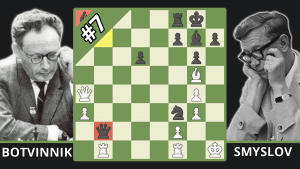
One of the greatest chess rivalries is Mikhail Botvinnik vs. Vasily Smyslov. Together, these two players contested three world championship matches, second only to the great rivalry between Garry Kasparov and Anatoly Karpov. With one match draw an...
Coming in at number eight on my list of the best chess games of the 1950s is a little-known gem contested between Mikhail Beylin and Isaac Lipnitsky from 1950. While many may not know Lipnitsky, in this year he finished second in the Soviet Champi...
Pablo Moran Santamaria is not a player many will have heard of, but he was a respected chess journalist who wrote an acclaimed biography of Alexander Alekhine. In 1955, against a fellow Spaniard, he also played a masterpiece that rivals Alekhine's...
The 1960s might be my favorite chess decade. In some ways, it was a golden age for chess. The world championship cycle was stable and (mostly) working well with regular Zonals, Interzonals, and Candidates Matches producing exciting chess and gener...
Mikhail Tal is the 8th World Chess Champion, reigning from 1960-1961. At that time, he was the youngest world champion of all time, and his meteoric rise to the top of the chess world was unprecedented in the modern chess world.
We now know that...
Bobby Fischer's stature as a near mythic figure in the chess world is based on many things—his performance as a prodigy, his domination in many events, his brilliant and ambitious victories, and his ultimate shocking departure from chess.
...
The great Rashid Nezhmetdinov (whose birthday is today!) is a unique figure in the history of chess. Although he never became a grandmaster, he was a tremendously strong player who won the Russian Championship five times. He was also a tremendous ...
There are a lot of "greatest" games in chess history. Greatest game in a world championship, greatest blitz game, greatest bullet game, greatest King's Gambit, etc. The categories seem endless at times, and of course, that is part of the fun. Ches...
Lev Polgaevsky and Mikhail Tal had an incredible chess rivalry featuring numerous brilliant battles.Tal's last victory (He only won two and lost eight.) was a prize-winning game in the Informant magazine.
The most famous and brilliant of their c...