Global warming - an urgent problem requiring radical solution (no politics or religion)

Sort:
Avatar of Ghostliner
s23bog wrote:

Sure, it's been repeated enough by a bunch of talking heads reading from scripts.

Scripts?

You might try raising your eyes from that bible of yours and looking out the window from time to time, it would do you the world of good.

The Swedish government announced two weeks ago that the Arctic is on fire, they have reported that over fifty wildfires are raging in their territory, all above the Arctic Circle. So if you're not seriously concerned about global warming yet now would be a good time to start.

Avatar of Elroch
s23bog wrote:
Elroch wrote:
[something about human caused climate change]

I do not disagree with you about people having an impact on the weather.  I think you are, however, underestimating the degree to which we effect the weather and the earth with our very breaths, our every step, our every finger waving and button pushed.

No, because I know that the CO2 in people's breath is about 8% of total human emissions and this all comes from food which is part of the carbon cycle. This is quite different to the one way conversion of fossil fuels to CO2 which is why CO2 levels have gone up about 50% since 1900.

That being said, conversion of land for agriculture is a massive pressure on the environment, and modern agriculture relies heavily on fossil fuels. These are two issues that desperately need to be ameliorated.

Avatar of zborg

How long must the entire East Coast of the United States be drenched with rain, until somebody calls them out on these extreme weather events being driven (partly or largely) by GCC?  Ellicott City, in Maryland was recently flooded (with deaths), and now Lynchburg, Virginia is threatened with a dam breaking and (according to today's BBC online) a 17 ft. (potential) tsunami blasting through the town.  Don't believe me, believe your lying eyes, via the BBC.  Another example below --


https://www.bbc.com/news/av/world-europe-45058171/europe-heatwave-why-are-spain-and-portugal-so-hot

Avatar of Senior-Lazarus_Long

You know it's hot out there when even the soil is hyperventilating.

According to a new study published yesterday (Aug. 1) in the journal Nature, there's about twice as much carbon dioxide (CO2) stored in Earth's soil as there is floating around the atmosphere, and for the last few decades, that underground greenhouse gas has been leaking out at a significantly increased rate.

Based on more than 2,000 sources of climate data taken from ecosystems around the world, a team of soil scientists found that the rate of CO2 released from Earth's soil has increased globally by about 1.2 percent in just 25 years — and you can blame that on hot, hungry microbes.

Avatar of Elroch
s23bog wrote:
Elroch wrote:
s23bog wrote:
Elroch wrote:
[something about human caused climate change]

I do not disagree with you about people having an impact on the weather.  I think you are, however, underestimating the degree to which we effect the weather and the earth with our very breaths, our every step, our every finger waving and button pushed.

No, because I know that the CO2 in people's breath is about 8% of total human emissions and this all comes from food which is part of the carbon cycle. This is quite different to the one way conversion of fossil fuels to CO2 which is why CO2 levels have gone up about 50% since 1900.

That being said, conversion of land for agriculture is a massive pressure on the environment, and modern agriculture relies heavily on fossil fuels. These are two issues that desperately need to be ameliorated.

You are misunderstanding me with great regularity.

You said "you are underestimating the degree to which we effect the weather and the earth with our very breaths".

I pointed out that I already had a quantitative understanding of this, so you were wrong.

Avatar of Elroch

Well, if you think our breath affects the weather in any other way, you are out of touch with reality.

Avatar of Elroch

Climate is not weather. It is the description of the long term statistics of weather. For example, when the climate gets warmer, the average amount of time at higher temperatures goes up and that at lower temperatures goes down. Simple enough.

CO2 affects the climate across the world. It is the biggest factor causing CHANGE in the climate across the world (in combination with methane and other greenhouse gases).

Natural factors affecting weather are close to cyclic. Their underlying averages are not changing in a way which has a significant effect (eg the solar output, the distance from the Sun, the tilt of the Earth). They can have a significant effect on climate over tens of thousands of years. This is a different issue.

Avatar of Elroch
s23bog wrote:

You say it is the biggest factor.  I would like to suggest that it is perhaps the biggest KNOWN factor.  Saying it is the biggest factor is like saying that you know it all when it comes to the weather.  I know better.

If you learn the difference between weather and climate, that will be your first step towards understanding what others know about the factors that affect climate.

Avatar of Elroch
s23bog wrote:

There are a number of times in my life when the weather changed quite dramatically on a word from me.  


That is just delusional.

Avatar of wickiwacky

The force is strong with this one. Not necessarily good - but strong happy.png 

Avatar of Senior-Lazarus_Long

The choice is clear—rethink how we grow food, or starve. Environmental scientist Dickson Despommier of Columbia University and other scientists propose a radical solution: Transplant farms into city skyscrapers. These towers would use soil-free hydroponic farming to slash demand for energy (they'll be powered by a process that converts sewage into electricity) while producing more food. Farming skyward would also free up farmland for trees, which would help remove carbon dioxide from the atmosphere. Even better, vertical farms would grow food near where it would be eaten, thus cutting not only the cost but the emissions of transportation. If you include emissions from the oil burned to cultivate and ship crops and livestock in addition to, yes, methane from farm-animal flatulence, agriculture churns out nearly 14 percent of the world's greenhouse-gas emissions.

https://www.popsci.com/cliff-kuang/article/2008-09/farming-sky

Avatar of Senior-Lazarus_Long

Avatar of Senior-Lazarus_Long

nullnullnullnull

Avatar of wickiwacky

How Atlantic upheaval will make future weather even more chaotic

The current that ferries water around the Atlantic stabilises the climate for millions. Now it is getting weaker, which could bring more extreme heatwaves and floods

TippingOceansMAIN

Photomontage: Andrey Polivanov/Chantawute Chimwan/Shutterstock


THE northern hemisphere is roasting. Greece is battling lethal wildfires, and even the UK’s weather has been so hot and dry that record-breaking fires have broken out in its usually damp climes. In Oman on the Arabian peninsula, thermometers registered the hottest night on record anywhere on Earth on 28 June: the temperature never fell below 42.6°C.

Climatologists have been quick to point out that extremes are to be expected in a warming world. But there may be more to it than that. The ongoing European heatwave may have been made worse by a consequence of climate change rearing its head after decades of Cassandra-like warnings. For more than a century, the oceans have been changing right under our noses, as a powerful Atlantic current has weakened. The result, it seems increasingly likely, is more extremes of both heat and cold on both sides of the Atlantic – and the prospect of even more dramatic switches to come.


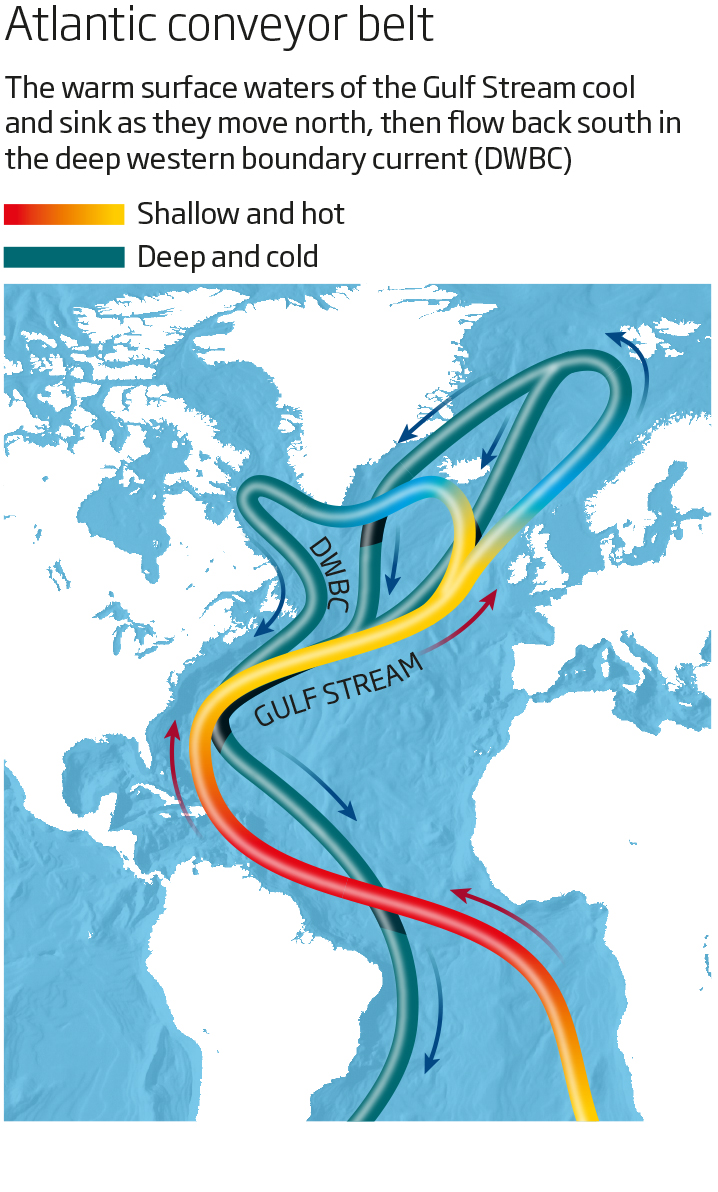
The object of concern is the Atlantic ocean conveyor belt, also known as the Atlantic meridional overturning circulation or AMOC. It is part of a global network of currents that push all the water in the oceans up and down the length, breadth and depth of the various interconnected basins. From the tropical Atlantic off the coast of South America, warm surface water flows north towards Greenland and western Europe, bringing with it an uncharacteristically warm climate, carried by the Gulf Stream.

The water becomes saltier as it evaporates, and cools as it moves north. Both factors make it denser so that by the time it reaches the Norwegian and Greenland seas, it has sunk by 2 or 3 kilometres. From there, it makes its way back south at depth (see map). Changes in salinity and temperature in the north Atlantic drive the entire set-up, which has caused concerns that chaos might ensue if anything changes in that region.

Atlantic conveyor belt


in-art-close-icon-128x128-16481b937f87b244a645cdbef0d930f8.png
–– ADVERTISEMENT ––
 
 
opt-out-icon2.png


In 1961 oceanographer Henry Stommel showed that, in theory, these currents could exist in one of two states, with water flowing in opposite directions depending on the balance of temperature and density. At the time, this was just a curiosity. In the 1980s, growing evidence that greenhouse gas emissions were heating up the planet caused concern that much of the Arctic’s ice would melt, including Greenland’s ice sheet. Climatologists warned that fresh water pouring into the north Atlantic would slow the natural sinking of AMOC waters, and put a brake on one end of the conveyor belt.

Then came the finding that the Atlantic conveyor belt had stalled during the last ice age, between 110,000 and 12,000 years ago, when much of northern Eurasia and North America were covered in ice. Battalions of icebergs periodically broke off and went marauding around the Atlantic. Spiked by fresh water, the AMOC weakened.

“Because there were similarities between what happened then and what we were predicting in the future, that caused concern that the AMOC could weaken in the future,” says David Thornalley at University College London.

The notion was made famous with the 2004 disaster movie The Day After Tomorrow, in which the AMOC shuts down in a matter of days, triggering a snap ice age across Eurasia and North America and ocean-spanning mega-storms. In just one of the many exaggerated scenes, characters run away from a wave of extreme cold that instantaneously freezes anything in its path.

“Intense heatwaves could be one result of a weaker conveyor belt”

In reality, a total collapse would probably take decades or a century. The most likely effect would be extreme sea level rise on the US eastern seaboard, extreme heat in Europe and chaotic monsoons in Africa and Asia (see “The consequences of collapse”).

By coincidence, the year after The Day After Tomorrow was released, Harry Bryden of the National Oceanography Centre in Southampton, UK, and his colleagues claimed that the current had recently slowed by 30 per cent. Using data collected on five research cruises that crossed the Atlantic between 1957 and 2004, they found that the amount of heat being transported north had dropped significantly. A media storm ensued, but Bryden’s evidence was sparse. The main issue was that the current’s strength might vary naturally, from day to day, season to season or decade to decade. Bryden’s study could have mistaken a temporary wobble for a long-term decline. At the same time, climate models suggested that his slowdown was, in fact, down to natural variability.

Nevertheless, researchers started keeping a closer eye on trends. In 2004, instruments were deployed to monitor the AMOC. One of these, the RAPID array, relies on an undersea cable running beneath the current, from Florida to the Bahamas. Because the AMOC carries lots of salt, it contains charged ions, and their movement sets up a voltage in the cable, which can be used to estimate the current’s strength. Later, a second array was installed from Labrador in Canada to Scotland.

Thanks to RAPID, we now have 14 years of continuous data. “It basically showed that the AMOC has huge variability,” says Laura Jackson at the UK Met Office. Bryden himself co-authored a study of the first four years of RAPID data, showing that the current is strongest in the northern hemisphere autumn and weakest in spring. In it he acknowledged that seasonal changes “might have accounted for a large part of the inferred slowdown”.

https://d1o50x50snmhul.cloudfront.net/wp-content/uploads/2018/08/30140321/ac376088-300x200.jpg 300w, https://d1o50x50snmhul.cloudfront.net/wp-content/uploads/2018/08/30140321/ac376088-768x512.jpg 768w, https://d1o50x50snmhul.cloudfront.net/wp-content/uploads/2018/08/30140321/ac376088-600x400.jpg 600w, https://d1o50x50snmhul.cloudfront.net/wp-content/uploads/2018/08/30140321/ac376088.jpg 1200w, https://d1o50x50snmhul.cloudfront.net/wp-content/uploads/2018/08/30140321/ac376088-800x533.jpg 800w" alt="waves" /> A collapse of the Atlantic conveyor belt could raise sea levels (above) and shift monsoon rains (below) with devastating effect

Netherlands Ministry of Defence/Eyevine

dried mud

Prabhat Kumar Verma/Eyevine


This comforting conclusion was reinforced by further data. In the winter of 2009-10, the AMOC weakened by 30 per cent, but recovered the following year. The belief is that strong surface winds blowing against the current might have put the brakes on. In this light, Jackson says, many people concluded that the original finding was “a fluke”.

Things began shifting three years ago. To get around the variability problem, researchers sought data spanning even longer timescales. Stefan Rahmstorf at the Potsdam Institute for Climate Impact Research in Germany and his colleagues looked at how sea surface temperatures varied worldwide from 1901 to 2013. Mostly, they found a warming trend, but in the north Atlantic, a blob-shaped region had cooled, particularly since 1970. Tellingly, climate models suggest that such a cool spot is a sign of a weak AMOC.

Just months after Rahmstorf’s study was published in March 2015, Europe was hit by a scorching summer that broke a number of temperature records. The following year, Aurélie Duchez of the National Oceanography Centre in Southampton, UK, showed it was linked to the cold spot in the north Atlantic. In the past, similar heatwaves were more likely if the cold spot was more intense. We now have evidence that this mechanism has operated for millennia. It seems the AMOC moderates Europe’s weather, reducing both winter storms and summer heatwaves. Losing it unleashes both. A related possibility is that the recent spate of extremely cold winters and snowstorms in the eastern US might be linked to the current’s weakening. The idea is that the cold patch in the north Atlantic affects the jet streams over North America, unleashing blizzard after blizzard.

“The Atlantic slowdown is unprecedented in the past millennium”

Back in Rahmstorf’s team, there was another significant finding. Michael Mann of Penn State University had previously estimated how surface temperatures had changed since AD 900, using records contained in tree rings, marine sediments, ice cores and corals. In that data, the team found no previous signs of a north Atlantic cool spot. They concluded that the AMOC slowdown since 1970 was “an unprecedented event in the past millennium”.

“When that came out it was quite controversial,” says Jackson. Some questioned whether the cold blob might simply have been caused by something else.

That looks increasingly unlikely. For one thing, it turns out that the older climate models – the ones that had suggested the AMOC was stable during the 20th century – were probably biased towards producing a stable current. For example, Wei Liu of the Scripps Institution of Oceanography in California showed last year that the models don’t capture how salt moves around the oceans. When this issue was resolved, the simulated AMOC became more prone to collapse. Better models have shown that the current can be pushed into an “off” state by fresh water – coming from a melting Arctic, for instance – and will then stay off for more than 400 years.

Earlier this year, three studies offered critical evidence that a slowdown is already under way. The first was led by Marilena Oltmanns at the GEOMAR Helmholtz Centre for Ocean Research in Kiel, Germany. She and her colleagues focused on the Irminger Sea south of Greenland from 2002 to 2014. They found it to be unusually warm and low in salt for several summers, particularly 2010 – exactly the conditions that would weaken the AMOC. What’s more, the winters that followed were so mild that the water never cooled enough to sink properly. More often than not, a quarter of the fresh water was still there as spring broke, suggesting the convection current wasn’t working as it should.

Then in April, Rahmstorf returned to the fray, armed with better evidence that the north Atlantic cool blob really was a signature of a weak current. His team also reconstructed how the current had changed from 1870 to 2016, and showed that it had weakened by 15 per cent since the middle of the 20th century and, after a brief recovery in the 1990s, had been declining steadily throughout the 21st century.

Finally, Thornalley and his colleagues examined Rahmstorf’s claim that the weakening was bigger than anything in the past 1000 years. They focused on one part of the current: the deep western boundary current or DWBC, which carries the cold waters back south (see Map).

To find out how it had changed over centuries, they used sediment cores that had been drilled out of layers of mud and sand on the bottom of the Labrador Sea. The team measured the sediment grains – bigger grains meant a faster current. “A fast-flowing mountain stream has a rocky boulder bed, whereas a slow meandering river has sediments at the bottom,” says Thornalley. In this way, the sediments offered direct evidence of what was happening in the deep-sea currents. They found that the DWBC began weakening around 1750. By 1870, it was significantly weaker than at any point in the previous 1500 years. It has slowed ever since.

Total collapse

Put all the evidence together, and the case that the AMOC is getting weaker starts to look quite strong. “From a whole range of different types of evidence, we get the same answer,” says Thornalley.

“If I had to guess, I would say the AMOC is decreasing and it’s not just an internal variability that is occurring,” says Giovanni Sgubin at the University of Bordeaux in France. Jackson and Oltmanns remain cautious. Jackson wants a few more years of RAPID data, among others, before she accepts that a slowdown is under way.

So a weak AMOC could already be affecting weather patterns, but what about the more extreme possibility: a collapse, with the more violent climatic impacts that would follow? The core problem with predicting that eventuality, says Rahmstorf, is that even after decades of study, it is unclear how big a “push” is needed for collapse. As the AMOC slows down, it comes closer and closer to a theoretical tipping point that would lead to its collapse, but “we still don’t know how close to that threshold we are”.

“Although we think it’s very unlikely that you would get a sudden collapse of the AMOC, obviously the impacts from that would be huge,” says Jackson. She calls it “a low-probability, high-impact event” – like a financial crash. Only with far worse consequences.

T

The consequences of collapse

The Gulf Stream is notorious for the warm glow it brings to the UK and the rest of western Europe. But if the Atlantic Ocean conveyor belt (or AMOC) were to collapse, the Gulf Stream would vanish, cooling Europe and possibly beyond.

Some have painted this as a good thing. After all, as temperatures soar because of climate change, surely a bit of fresh air can’t hurt? One study argued that an AMOC slowdown would avoid the many harms a rapidly warming climate would unleash on Europe.

Not so fast. For starters, a weaker AMOC would shift water around the Atlantic, leading to extremely rapid sea level rise along the US east coast – adding 15 to 21 centimetres at New York City by 2100 according to one estimate. This would bring more severe flooding whenever storms hit.

It also isn’t certain that there would be cooling. A recent study suggests that a weaker AMOC might reduce the deep ocean’s ability to store heat, boosting atmospheric warming.

Any cooling that did occur would be localised. “The heat has to go somewhere,” says David Thornalley at University College London. “The north Atlantic might get colder, but it means everyone else is getting a bit warmer.” The effects for the rest of the world are murderous. In Central America, Africa and southern Asia, billions of people depend on monsoon rains. A weakened AMOC would shift them hundreds or thousands of kilometres north or south, leaving many regions parched.

“Collapsing the [AMOC] would probably be very bad news for the west African Sahel monsoon,” says Tim Lenton of the University of Exeter, UK, adding that the people living there are already among the most vulnerable to climate change.

Back in Europe, cooler temperatures mean less water evaporating to form clouds, which would also make everything drier and affect farmers. The region would get more severe heatwaves, more winter storms and floods; the US may also suffer more extreme winters. Some of these effects are already being felt.

Finally, a weaker AMOC would affect marine life, including some we depend on. “Important fisheries like cod and mackerel, will migrate with changing circulation patterns,” says Thornalley, adding that some currents play a key role in spreading larvae.

Avatar of Senior-Lazarus_Long

https://www.livescience.com/63252-climate-change-increases-vibrio-bacteria.html?utm_source=notification

Avatar of Elroch

That's because your thinking is superfical and glib and ignores all of the vastly more detailed work by those who are expert in this field. You can't seriously think that poorly informed guesses deal with everything that matters?

Avatar of testaaaaa

has like 40 degrees tday arrrgggh

Avatar of Elroch

No. Do you think that puts you in a position to glibly ignore climate science?

Avatar of wickiwacky
s23bog wrote:

In a carbon rich atmosphere, shouldn't plants thrive?  So, it seems that we may have a shift to more plant life and less animal life (including humans).  As the shift becomes more Oxygen rich, then there will be a shift back.  I don't really see any cause for alarm.


Not necessarily. Some plants will fare better in some areas and some will be worse off. And if the heat leads to droughts (as it is doing already) that will obviously make farmed crops more dependent on irrigation - if more water is available in that area. And in some places it won't be. Basically it is unrealistic to say that changes in climate will not lead to movement of large numbers of people over the next few decades.  So if you are not alarmed by people dying or having to become refugees to survive then perhaps you need to rethink your moral outlook on life. 

Avatar of XemeNode

...