

Playing Chess Variants

Hello!!
Today, we will learn about one of the variants of chess : Four Player Chess.
Four Player Chess :-
The simple explanation is that "play solo or with a friend to win".
Four Player Chess Rules :-
There are 2 main variations of 4 Player Chess (4PC): Teams and Free-for-All.
Teams -
Gameplay begins with the Red player. Clockwise move order : Red, Blue, Yellow, Green.
Your teammate is the player across from you.
You cannot capture your teammate's pieces.
Pawns promote on your 11th rank.
Checkmate only happens when the checkmated player's turn is reached.
The first team to checkmate an enemy player wins!
Stalemate is a Draw.
A player that resigns or times out on their first move will lose some rating, and the game will be aborted.
A disconnected player has 60 seconds to reconnect before being forfeit on time.
Right Click + Drag to draw arrows. Your teammate can see your arrows and you can see theirs!
Click anywhere on the board to clear the arrows. Shift + Click to clear only your own arrows.
It is recommended to review the Strategy Tips For Teams -
If you have ever tried teams you should know that the variant is very different than FFA. Here are some tips on the teams variant. Note that I am also still learning this variant, so my opinion on some things might change over time.
1. Communicate with your partner!
Since you are in a team it is really important to play as a team. You can draw arrows by right-clicking and dragging. Clear arrows by left-clicking. Using chat and arrows for communication with your partner will greatly improve your teams overall play.
2. Play actively!
It is really important to play actively with your pieces. Not only will this make it easier to create tactics with your partner, but you will also be able to help your partner if he is attacked.
3. Always look for tactics!
This is a very tactical variant and you constantly want to create tactics with your partner and avoid tactics from your opponents. Look for forcing moves, which are checks, captures and threats. Be very careful of checks. If you get double checked by 2 queens, then you are quite likely to get mated soon if you are not mated already. Also note that I really mean to always look for tactics. This includes the first moves made in the game (you can blunder on move 1!).
4. Develop your queens early!
This might sound a bit controversial. Haven't you been taught not to develop your queen early in classical chess? Well there are a lot of squares on the 4 player chess board and the queens tend to find squares where they can stand safely and aggressively at the same time. There are also usually no easy way for your opponents to harass the queens to get ahead in development and they constantly need to watch out for tactics (especially double checks by both queens tend to be deadly). There might be other good approaches where you don't develop your queens early, but you do not want to end up playing a middlegame with an inactive queen.
As a side note it is certainly possible to move your queen too many times in the opening when you do end up behind in development because you were just trying to checkmate early. When it is good/bad to move your queen several times in the opening is a very complicated topic that I will not cover here, but I hope you put your queen on a better square if you move it several times.
5. Don't be afraid to trade!
It is important not to misinterpret this advice. You should not be afraid of trading pieces when both teams looses the same amount of material. However, being on the receiving end of a trade where you have to recapture can often be quite risky since it might be possible for the one initiating the trades partner to create a tactic against you when you want to recapture on your next move. So make sure your move is tactically safe before offering a trade.
Finally I want to mention that this is a very tactical variant and new players will have a hard time to survive the first 10 moves against experienced players. Don't be ashamed of falling for early checkmates, everyone does that at the start. Also for those wondering how you can blunder on move one, see this -

It is also recommended to join the 4 Player Chess Club.
Free-for-All (FFA) :-
The goal is to finish with the most points of any player.
Points may be earned in the following ways :
• Checkmating an opponent :
+20 points
• Stalemating yourself +20
• Capturing active (coloured) pieces :
Pawns +1, 1-point Queens +1.
Knights +3, Bishops +5, Rooks +5, Queens +9,
Kings +20, Spare kings +3.
• Checking two players simultaneously :
with a Queen: +1, otherwise +5.
• Checking three players simultaneously :
with a Queen: +5, otherwise +20.
Pawns will promote on your 8th rank.
Pieces become “dead” (grey) when a player is eliminated. Capturing dead pieces does not award any points.
Gameplay begins with the Red player. Clockwise move order : Red, Blue, Yellow, Green.
The game is finished when three players have been eliminated.
When a player resigns or times out, their army will become “dead” but their King remains "live" and will continue to move at random until checkmated or stalemated. Points for stalemated resigned kings are shared.
The last remaining player will be given +20 (or 40) for each live king (except his own) left on the board.
In case of insufficient material, 3-fold repetition or the 50-move rule, the remaining players receive +10 points each.
Total points do not directly affect rating calculations, only final placement does.
If a resign (or timeout) occurs before all players have made at least 3 moves and no one has points yet, and the player that resigned wasn't in check, the game will be aborted and he or she will lose rating. (For some variants and bullet games : first move only).
A disconnected player has 60 seconds to reconnect before being forfeit on time.
IMPORTANT: Players must think independently. It is prohibited to suggest moves and/or coordinate attacks using chat (or other means of communication) during FFA 4PC games! Also players may not discuss blunders which can be fixed, but may discuss what already happened and cannot be undone. If you break this rule you will be chat-banned or even play-banned! Examples of prohibited phrases: "Check red", "Let's attack green together", "I won't take your queen", "Mind your rook", "Protect your pawn", "Mate in 2", "Resign!", "Don't resign". You can use these and similar phrases in chat after a game, but not during a game.
IMPORTANT: It is prohibited to ask other players to give you points! For example: "Give me 7 points and I will resign.", "Just 5 points, ple-e-ease!" You can be chat-banned for doing this.
Note: these rules do not apply to Diplomacy Games -
Summary:
Teaming, including teaming in chat, is not only *allowed* but *expected*.
Arrows are public. Players can send private arrows and chat messages.
Note: Private chat is not saved or moderated. Chat cannot be disabled (click the speaker for muting)
Hold keys 1/2/3/4 pressed to draw arrows for Red/Blue/Green/Yellow only (and the spectators).
Type /r (/b /y /g) and then your private message to Red/Blue/Yellow/Green (to multiple: /gb etc).
If combined with anonymous, chat is not disabled, rather the players can chat as 'Anonymous' (in player's colour).
Introduction
Four player chess variant ‘Diplomacy’ is based on the Avalon Hill game of the same name. It was initiated by VAOhlman, for two reasons:
1) Because there were innumerable reports of players ‘cheating’ by teaming and the more that VAOhlman analyzed the rules and the game play the more he became convinced that 4PC FFA would inevitably be plagued by these problems… as long as ‘teaming’ was considered cheating.
2) He liked to play the Avalon Hill game ‘Diplomacy’ which was predicated on the exact opposite premise: that ‘teaming’ was not only to be allowed, but to be encouraged.
Concept
In 4PC Diplomacy Variant players can, quite naturally, team up with other players; for one move, two moves, till a certain time, whatever.
In order to facilitate this the rules for teaming were obviously eliminated, and a system of ‘private’ chats and arrows were enabled. These ‘private’ chats and arrows are just that, no visible to anyone outside of the person you send them too. They are not moderated or kept in the archives.
In addition there are public chats and arrows. With the right settings even the spectators can join in and kibitz.
Recommended Settings
4PC allows for a huge range of settings. Some recommendations for these:
1) Solo play will produce a better effect for the type of game play that the diplomacy variant is meant to produce. No player should be shooting for ‘second place’.
2) Especially for weaker players a longer time frame should be used. The standard one minute doesn’t really allow for much discussion. This isn’t to say that quicker time frames, with the necessity for really quick diplomacy, might not be helpful.
3) Spectator chat allowed. Doing this will sort of allow the spectators to be part of the game, adding a fun element to the game.
Teaming
Teaming in the diplomacy variant can be simple or complex, one move or multiple. For example:
Pointing out moves:
Blue says to Red ‘xb3’
Red looks at the board and realizes that his bishop can take Green’s queen at b3. Why would Blue tell Red about it? Maybe cause Blue is busy attacking him? Maybe to distract Red. Red should know that Blue obviously thinks it would be good for Blue to have Red take the queen. But that doesn’t mean that it is bad for Red!
Combination Moves
Blue says to Red ‘xb3 xc3’ (by means of private chat and arrows..)
Red looks a the board and realizes that if he takes b3, and Blue takes c3, they will have a mate on Yellow. Blue would get the mate, but Yellow is really bothering Red. So… do it, or not? Red has to decide.
Truce
Blue chats to Red, “Hey, let’s have a truce until we mate Yellow.”
Red thinks about that. Yellow is getting pretty strong..
Blue chats to Red, “Hey, let’s have a truce until it is just the two of us are left…”
You get the idea.
Full Blown Teaming
Two players discuss and team up in order to win.... until they don't (see 'Backstabbing') below.
Backstabbing
Backstabbing is a core idea of Diplomacy. But very, very dangerous. Teaming relies upon trust, and winning depends upon gaining advantage. Backstabbing (saying or implying you are going to do one thing, and doing another) gains advantage, but destroys trust. So… your choice.
Before giving tips I think it is important to understand the goal of the game. The goal is NOT to checkmate first. The goal is NOT to be the last player standing. The goal is NOT to have as many points as possible. The goal is to have more points than your opponents at the end of the game. It doesn't matter if you have 1 more point or 20 more points than the player player behind you. Additionally the game is not just about 1st place. If you have no chance to get 1st you can still try to get 2nd or 3rd. With this in mind, let's get to the tips:
1. Never resign!
I am not talking about claiming victory by resigning which will be covered later. Premature resignation is far too common in this variant. If you lose a lot of material early, then there is still a chance for a comeback. And I am not talking about merely losing a queen here. You can lose a queen, rook and 2 bishops and I would still argue that it is too early to resign. Even a position where you are mate in 1 is too early to resign. The thing is that to get as high place as possible you should try to get as many points as possible. It is very pessimistic if you think it is impossible for you to get at least 1 more point before you are checkmated. When it comes to positions where you are mate in 1 you should know that there are more players than the player that tries to checkmate you. The other players may want to prevent him from mating you or let him pay for it by attacking that player. When it gets to that players turn he might choose to prioritize something other than mating you (such as king safety or saving his queen).
2. Don't trade early!
The thing about trades is that if you trade a piece with another player, then you both lose a piece and the other players will have one more piece than you. In other words a trade is bad for both players involved. While the goal of the game is to get points, those points will come if you stay in the game for a long time. I'm not going to discuss to what extent you should avoid trades here, I just want you to know that trades are generally bad for you.
3. Watch out for the diagonals!
The bishops are a scary piece in this variant. Their worth about the same as a rook. One mistake many beginners do in this variant is to develop their bishops towards the centre and leave the pawn in front of their knight undefended. Another mistake many do is to leave themselves exposed to a check along a diagonal. You need to watch out for that and the typical way to deal with it is to block the diagonal with a pawn or develop your bishop on that diagonal yourself.
4. See checks as threats!
When a player is in check he must respond to the check and while doing this other players can try to take advantage of this by for example attacking a queen or capture a piece without giving the player a chance to recapture. This is especially true for checks by the player to your left, since there are 2 players after him that can take advantage of the check. So you should really try to avoid checks by him.
5. Claim win (victory by resignation)
If there are only 2 players left and your ahead by at least 21 points, then you can just resign and win the game (The button should say "Claim Win"). You should use this opportunity whenever you can.
Do you take into consideration which order your opponents make a move? Well, you should! Positioning matters in this variant.
First off let's talk about the person sitting in front of you. He is your best friend. Since he's pieces are far away from yours they rarely make contact with yours in the opening. In addition you both have the same enemies on the sides and if any combination happens against an enemy on the side, he is the most likely to help you. You also don't want anything bad to happen to your friend since you are unlikely to be able to join the party and get points from him. And you don't want your enemies to get free points.
Next we have the player to the right. He is a backstabber. If any other player checks you or make a move you need to respond to (like trading a piece), he will always be there and try to take advantage of it. However you should not fear him, he should be the one fearing you! If you initiate a trade or create a threat against him, then your best friend are ready to backstab him before he can respond. Whether you want your best friend to get points this way is up to you, but the backstabber should definitely fear you.
Finally we have the player to the left. He is your worst enemy. If he creates any check or threat against you there are 2 players after him that could take advantage of it. If you create a threat or check against him he can respond immediately without any other player taking advantage of it, unless they managed to predict your move. It's true the backstabber are the one most likely to gain from this, but you should fear the cause which is your worst enemy instead of the one dealing the damage. Also keep in mind that you want to be able to backstab your worst enemy.
Any thoughts on this view of positioning? Obviously the player I called best friend is also an enemy at the end of the day and this is a simplification of the players roles.
Solo :-
Solo games are Free-for-All games that are rated winner-takes-all (WTA), which means only the winner gains (Solo) rating, and 2nd-4th lose equally.
Variants :-
Variant games can be Solo, FFA, or Teams games.
The rules for the game are indicated above the board (mouse-over for descriptions).
In addition to the main 4 Player Chess variants Solo, FFA and Teams, there are Rule Variants which can be combined into many different 4 Player Chess Variants: (Click the links to read the variants rules and discuss them in their dedicated topics [These links are of the blogs of other Bloggers] ).
- Pawn Promotion https://www.chess.com/clubs/forum/view/4pc-variant-pawn-promotion
- Diplomacy https://www.chess.com/clubs/forum/view/four-player-diplomacy-variant
- Takeover Pieces of players you checkmate join your army (except pawns)
- Play-4-Mate No points for pieces. 1st checkmate = 60points, 2nd 30, 3rd 15.
- Opposite X (Ox) https://www.chess.com/clubs/forum/view/4pc-variant-opposite-x
- Anonymous https://www.chess.com/clubs/forum/view/4pc-variant-anonymous
- Chess 960
- Custom Starting Position https://www.chess.com/clubs/forum/view/4pc-variant-custom-starting-position
- King Of The Hill https://www.chess.com/clubs/forum/view/4pc-variant-king-of-the-hill
- N-Check (for example 3-Check) https://www.chess.com/clubs/forum/view/4pc-variant-n-check
- Capture The King (Regicide) https://www.chess.com/clubs/forum/view/4pc-variant-capture-the-king
- DeadWall https://www.chess.com/clubs/forum/view/4pc-variant-deadwall
- AntiChess https://www.chess.com/clubs/forum/view/4pc-variant-antichess-1
- Alternative Teams https://www.chess.com/clubs/forum/view/4pc-variant-alternative-teammates
- Blindfold https://www.chess.com/clubs/forum/view/4pc-variant-blindfold
- Ghostboard https://www.chess.com/clubs/forum/view/4pc-variant-ghost-board
En passant and Dead King Walking (DKW) became standard rules from 21-May-2019.
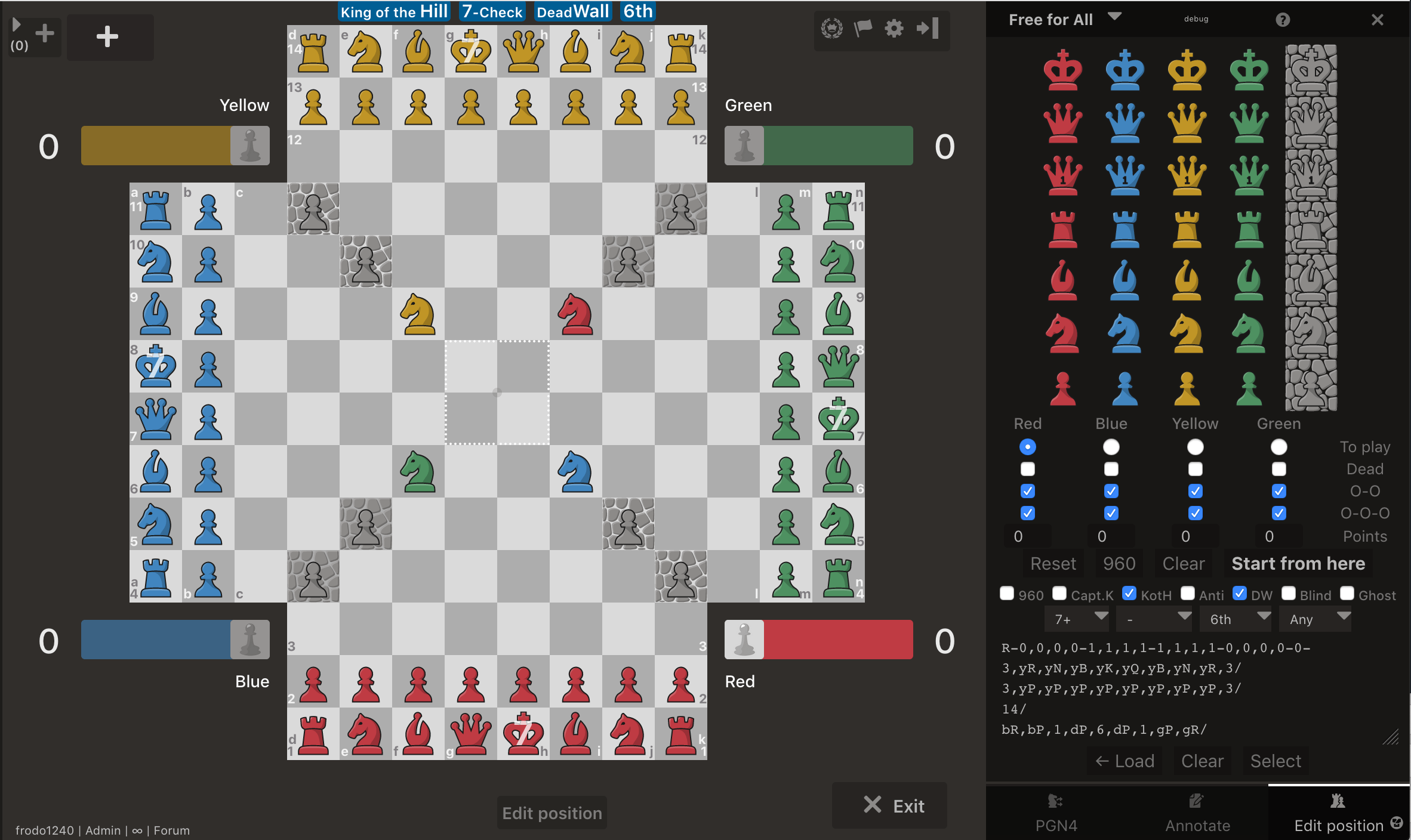
Experiment by setting different rule variants in the Edit position tab (click "Start from here" when ready).
Rule variants are read from pgn4, for example
[Variant "FFA"]
[RuleVariants "DeadWall 6-check Prom=5 PromoteTo=B"]
Other valid RuleVariants: Chess960=N (N from 1-960), KotH, CaptureTheKing, Antichess, OppositeX=2, teammate=1 (or =3), blindfold, ghostboard
For a custom starting position:
[StartFen4 "..."]
Stay tuned...more coming up soon!
Thank You!!!


